
One in three American adults uses AI chatbots like ChatGPT for health advice. These tools appeal to people seeking instant answers without scheduling appointments or paying consultation fees. Up to 80% of the population will experience back pain at some point in their lives, making spine-related questions particularly common. Using AI might seem reasonable for such a widespread health concern.
However, these chatbots can only define terms and summarize tips well. They cannot assess emergency symptoms, perform physical examinations, access your medical history, protect your private data or diagnose you for treatments. Understanding these limitations helps you use AI safely during your health journey.
The spine is a complex structure composed of 33 vertebrae, dozens of discs, nerves, muscles and ligaments. Diagnosing spine conditions requires understanding how these components interact and identifying which specific structure is causing your symptoms.
AI chatbots like ChatGPT and Anthropic’s Claude cannot perform this level of clinical analysis. They only process text patterns based on their training data. That’s why major health organizations and medical experts recommend against blindly using AI.
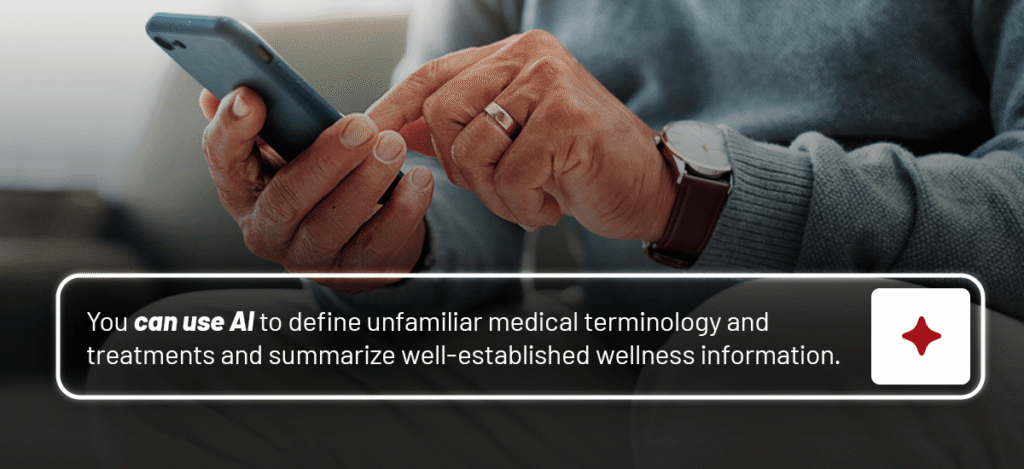
You can use AI to define unfamiliar medical terminology and treatments your doctor mentions and summarize well-established wellness information.
AI-powered diagnosis carries five critical risks:
Let’s look at each.
In a recent study, when ChatGPT Health was presented with cases requiring hospitalization, it advised users to stay home 51.6% of the time. Conversely, it created unnecessary panic by telling nearly 65% of perfectly safe users to seek immediate care.
Certain spine symptoms require emergency attention. Severe symptoms like sudden loss of bowel or bladder control can indicate serious spine conditions. AI chatbots cannot reliably distinguish these emergencies.
AI frequently provides incorrect medical information while sounding convincing. A study testing five major chatbots, including ChatGPT and Gemini, found that nearly 20% of their answers to medical questions were highly problematic, and a full 50% were problematic. Furthermore, none of the chatbots could produce an accurate list of references to back up their claims.
AI systems sometimes “hallucinate” information, generating plausible-sounding but completely fabricated details. You might receive recommendations for treatments that don’t exist or warnings about risks that aren’t real. This misinformation can lead you down dangerous paths when making decisions about spine surgery or diagnosis.
Entering personal health information into public AI tools creates serious privacy risks. A study in the Journal of Medical Internet Research highlights the security and privacy risks of using AI in healthcare, noting that sensitive patient data can be disclosed without authorization, leading to privacy breaches and other dangers.
When you describe your symptoms or imaging results to ChatGPT or similar platforms, that data may be stored, used for training future AI models or exposed in breaches. These platforms typically do not comply with the Health Insurance Portability and Accountability Act of 1996 (HIPAA) privacy rules that protect your medical information. Once you share health details with AI, you lose control over how your information is used.
These risks are not theoretical. In November 2025, OpenAI confirmed that hackers gained unauthorized access to customer profile data through its analytics partner Mixpanel, exposing names, email addresses and account information. While this particular breach affected Application Programming Interface (API) users rather than regular ChatGPT users, it demonstrates that security incidents do occur with these platforms. Any health information you share with AI tools faces similar exposure risks.
Spine diagnosis depends heavily on hands-on physical examination. A spine specialist tests your reflexes, measures muscle strength, evaluates range of motion and identifies specific points of pain. These physical findings help doctors understand how imaging abnormalities correlate with your actual symptoms.
An AI chatbot cannot test whether you have diminished reflexes in your ankle, weakness when lifting your big toe or pain that shoots down your leg when raising it straight. Physical examination provides crucial diagnostic clues that imaging alone cannot reveal. This limitation makes AI fundamentally inadequate for spine diagnosis.
AI lacks knowledge of your complete medical history, current medications, lifestyle factors and treatment goals. A proper spine diagnosis considers whether you have diabetes that affects healing, previous surgeries that impact your treatment options or work demands that influence recovery timelines.
Your diagnosis should account for your individual circumstances. A treatment approach suitable for a 30-year-old athlete differs from one for a 65-year-old with multiple health conditions. AI cannot make these nuanced determinations that require understanding you as a whole person rather than a collection of symptoms.
For something as important as your spine, expert evaluation makes all the difference. The spine surgeons at DISC personally review and analyze your MRI alongside the radiologist’s report to shape your diagnosis. Through tailored treatment plans, we focus on finding the least invasive approach to address your condition and help you return to your normal activities.
Call us at 623-303-0304 or fill out our online form to schedule your appointment.

Linked Sources:
 By Mark J. Wang, M.D.