
Living with chronic back pain can feel like an endless loop of discomfort and limitation. When rest, medication and physical therapy fail to provide lasting relief, the conversation turns to surgical options. However, the thought of traditional open spine surgery is often enough to make patients hesitate. Fortunately, advancements in medical technology have introduced a powerful alternative. Endoscopic spine surgery uses small incisions and leaves healthy tissue intact.
Learn the factors surgeons look for when deciding who is a candidate for endoscopic spine surgery. This will allow you to confidently discuss your surgical options with a spine specialist and take the next step toward improving comfort, mobility and function.
The selection process is rigorous to ensure the highest probability of success. The ideal candidate meets specific criteria regarding their treatment history, symptom presentation and overall physical health.
The most suitable candidates for endoscopic spine surgery have already exhausted nonsurgical methods without achieving adequate relief. A spine specialist will often look for a history of at least six to twelve weeks of conservative care.
Conservative therapies may include:
If you have pursued these treatment options and your pain persists, or if it returns shortly after treatment stops, you may be ready to consider a surgical solution. The goal of endoscopic spine surgery is to mechanically resolve the compression that chemical or physical therapies could not fix.

When evaluating candidates for endoscopic spine surgery, specialists look for a pain generator that is localized and can be clearly identified. This is often experienced as pain that radiates from the spine down into an arm or leg.
Patients who report vague, generalized backaches that shift locations may not get the same benefit as those with specific nerve compression symptoms. The ideal candidate often experiences:
The precision of the endoscope allows the surgeon to target these specific impingement points. If your magnetic resonance imaging (MRI) correlates strongly with your specific pattern of radiating pain, your spine condition may be suitable for the endoscopic approach.
While endoscopic spine surgery is significantly less invasive than open surgery, it is still a surgical procedure that requires the body to heal. Realistic recovery timelines and patient risk assessments depend heavily on the person’s general health profile.
Health factors include:
During the most advanced endoscopic spine surgery procedures, such as ultra-minimally invasive spine surgery (UMISS), the surgeon makes a quarter-inch microincision. Through this tiny portal, a small tube is inserted to create a corridor to the spine. A thin camera with a light source, called an endoscope, is passed through this tube, transmitting high-definition, magnified video of the spinal structures to a monitor in the operating room.
This visualization is superior to the naked eye. It allows surgeons to see the nerves, disc material and bone spurs with incredible clarity. Specialized micro-instruments are then used through the same or a second portal to perform the necessary work. This might be removing a herniated disc fragment or shaving down an overgrown bone.
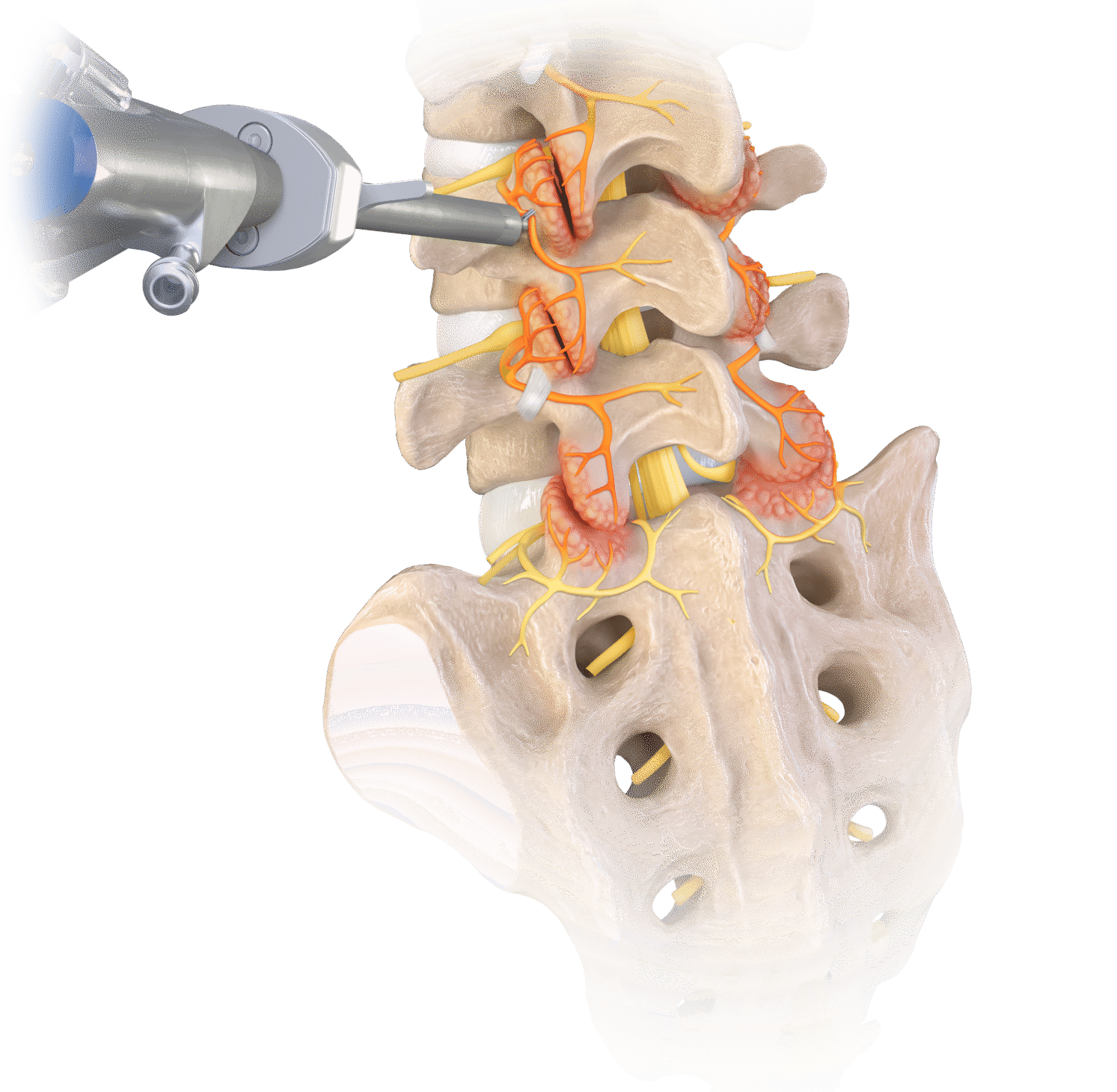
This approach contrasts with traditional open spine surgery, during which the surgeon makes a long incision and detaches or retracts significant amounts of muscle to expose the spine. This muscle damage is often the source of post-operative pain and stiffness. In endoscopic surgery, the muscles are gently pushed aside rather than cut. This preservation of the body’s natural anatomy enables such rapid recovery times.
Techniques continue to evolve. For example, highly skilled surgeons utilize Dual Portal® Endoscopic Surgery. This involves making two tiny incisions — one for the camera and one for the instruments, offering even greater versatility for complex conditions.
Candidacy often begins with a specific diagnosis. While the technology was originally developed for simple disc removal, advancements in endoscopic techniques have made the procedure effective for a broader range of spinal pathologies.
Common treatable conditions include:
For patients who fit the criteria, the advantages of choosing an endoscopic approach over traditional fusion or laminectomy are substantial. Endoscopic techniques offer outcomes comparable to traditional microsurgery but with significantly reduced surgical trauma.
Primary benefits of endoscopic spine surgery include:

Living with back pain does not have to be your permanent reality. If you have been diagnosed with a condition like spinal stenosis or a herniated disc, and conservative treatments have failed to give you your life back, it’s time to explore minimally invasive surgical solutions. Endoscopic spine surgery offers a pathway to relief that respects your body’s anatomy and prioritizes a swift return to activity.
At the Desert Institute for Spine Care, our surgeons are pioneers in minimally invasive techniques. We are dedicated to finding the least invasive solution for your pain and never rush our patients into the operating room. Our philosophy is rooted in compassion and precision, carefully matching the right treatment to your needs.
You do not have to navigate this decision alone. Schedule a consultation with our team today to discuss your MRI results and symptom history. We will provide a comprehensive evaluation to determine if you are a candidate for endoscopic spine surgery and help you understand all your treatment options. Let us help you take the next step toward a future defined by movement, not pain.
Linked Sources: