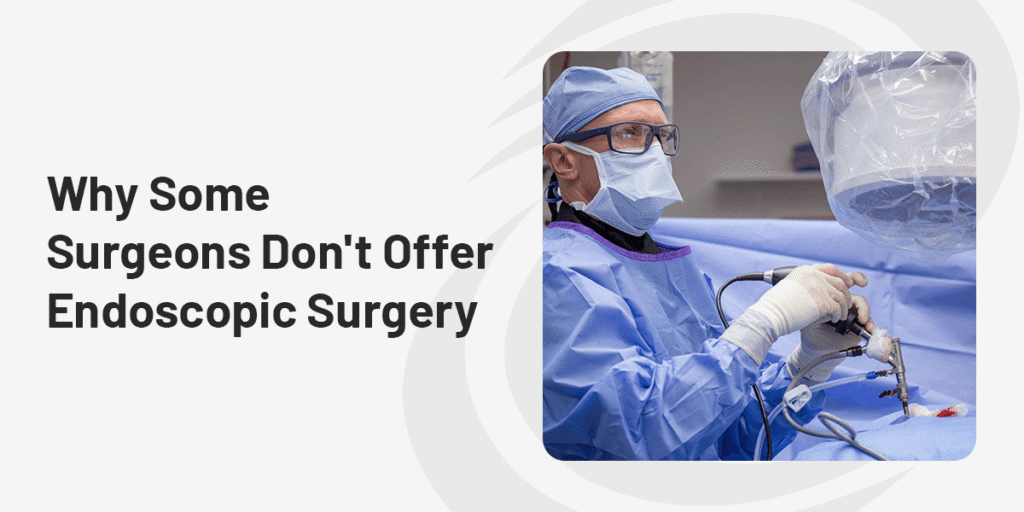
Endoscopic spine surgery has become a critical option for treating certain conditions and has significant advantages over other minimally invasive procedures. Endoscopic surgical techniques tend to result in less damage to the epidermal blood supply and faster recovery times.
This type of surgery requires the utmost precision, demanding considerable training and time to learn this specialized technique. For this reason, adoption varies across surgeons and medical centers. Read on to discover why many skilled surgeons aren’t trained in endoscopic surgery and how to verify a surgeon’s safety and experience with it.
Endoscopic spine surgery (ESS) is a spinal surgery technique using a tiny ¼-inch incision. In this ultra-minimally invasive approach, endoscopic spine surgeons use a small camera and instruments passed through a tube to the targeted area, guided by X-ray and real-time video. This lets surgeons operate safely and with greater accuracy, leaving healthy tissue intact.
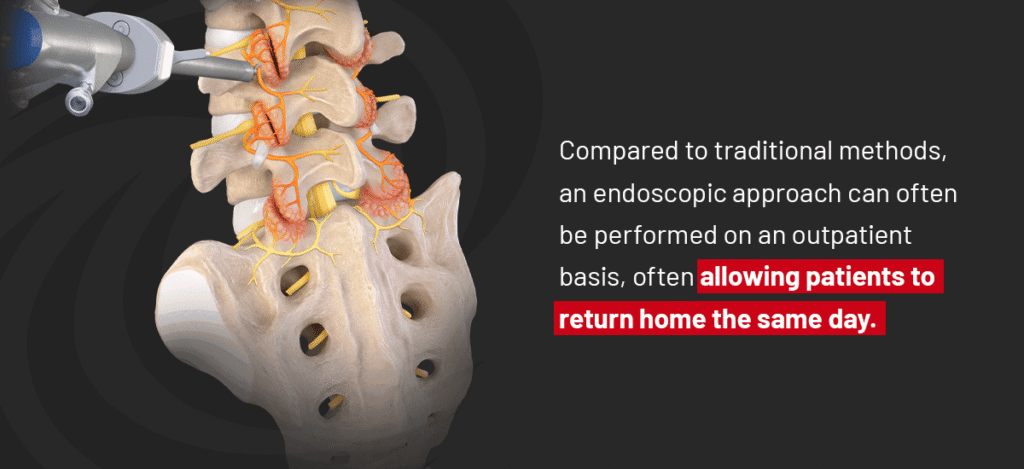
Compared to traditional methods, an endoscopic approach can often be performed on an outpatient basis, often allowing patients to return home the same day. Incisions are also so small that they can often be covered with a simple bandage. There’s also less blood loss, which, combined with the tiny incision, lowers the risk of infection and complications compared to open surgery.
While ESS has many benefits, the training, equipment and time dedication have kept it from being more widely adopted across different medical centers. Here’s a closer look at why some surgeons don’t offer endoscopic surgery:
Endoscopic spine surgery requires a fundamentally different skill set than traditional open surgery. Traditional open surgery relies on direct visualization with large incisions. ESS uses an indirect, high-definition visualization with an endoscopic camera on a monitor. This requires endoscopic surgeons to adapt to the instruments and new spatial understanding.
Most standard residency and fellowship programs in spine surgery haven’t fully integrated the training for these advanced endoscopic techniques. This means surgeons interested in ESS need to voluntarily pursue training after their formal education. During this time, they must perform numerous cases until they’re proficient in the technique and achieve consistent outcomes.
This learning curve is crucial for patient safety. Surgeons need to have the hand-eye coordination to work through the camera instead of looking directly. They need to be as precise and accurate as possible to avoid tissue damage and protect delicate nerve structures.
Adopting endoscopic surgery also involves a financial commitment. Hospitals and surgery centers that each surgeon operates at need to invest in specialized equipment, like advanced endoscopic towers, high-definition cameras, sophisticated imaging systems and various instruments and burrs made for endoscopic use.
Beyond equipment, surgeons must dedicate their own personal time and costs to learning the technique. Specialized courses, workshops and proctorships typically require travel and time away from their practices. For successful surgeons already trained in the traditional methods, choosing whether to adopt ESS becomes a business and career choice. They’ll need to consider whether they can divert resources to learning a new technique, especially if the high equipment costs aren’t offset by higher reimbursement rates.
Surgeons must only perform procedures in which they have the highest level of skills and experience. This is to ensure patient safety and achieve the best possible outcomes. Naturally, this can lead many surgeons to favor approaches they’re most experienced and comfortable with.
Surgeons are inherently cautious about adopting new techniques, especially in their learning phase, because they want to minimize any potential complications. They may also see limited data or evidence for endoscopic options in certain conditions. If a surgeon gets the same consistent, excellent results with a traditional fusion, they’ll confidently recommend fusion. Their comfort levels influence the treatment recommendation.
In contrast, endoscopic surgeons who have mastered the technique can confidently recommend ESS, as they’ve seen the superior recovery times and patient satisfaction benefits from the approach daily.
While endoscopic spine surgery can offer numerous benefits for many, it’s not a universal solution. Not every spinal condition or patient can be effectively treated with a minimally invasive approach. For example, cases involving severe spinal deformities, high-grade instability or multilevel pathologies will need broader exposure and instrumentation.
At Desert Institute for Spine Care (DISC), every patient undergoes a comprehensive assessment to determine the best, least invasive approach for their specific needs. Candidates for ESS can include those who haven’t found relief from conservative methods and have focalized spinal issues. They may also have specific spinal conditions, such as herniated discs, tumors, spinal stenosis, pinched nerves, disc degeneration and sciatica.
Research is crucial when searching for a surgeon to perform endoscopic spine surgery. You’ll need to determine the surgeon’s credentials and training. Be sure to ask plenty of questions about their volume and experience, such as how many endoscopic cases they perform each month and what specific fellowship or training program they completed. A higher volume of cases and more specialized training usually indicate proficiency.
If an initial consultation dismisses endoscopic options without a clear medical reason, consider seeking a second opinion from a recognized endoscopic spine specialist. DISC specialists have been leaders in endoscopic spine surgery for over 20 years. DISC’s founder, Dr. Anthony Yeung, pioneered and created the first endoscopic spine system. He passed on extensive training to DISC’s team of board-certified surgeons before retiring.
DISC’s surgeons prioritize customized spine care. We walk you through every step of the process, from appointments to treatment and recovery, to ensure the most comfortable, personalized experience. Our expertise has extended to patients all over the world, and we provide medical travel options for patients who visit from anywhere across the globe.
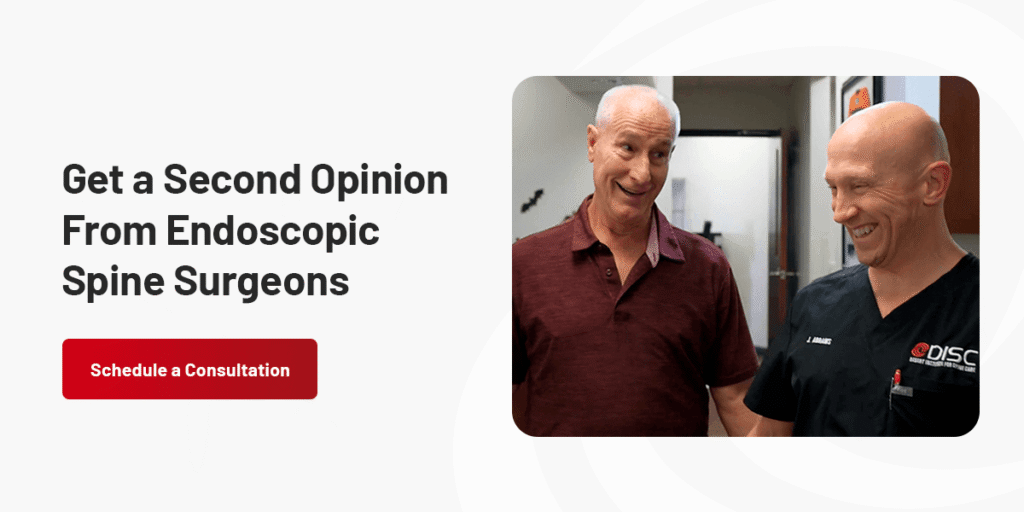
While ESS offers many benefits, not every surgical practice offers this minimally invasive surgery. If you’re exploring your spinal treatment options and are unsure if endoscopic surgery is right for you, turn to DISC. Our team will provide a thorough evaluation to determine the least invasive yet most effective treatment path for your needs.
Given the complexities and varying levels of expertise in endoscopic techniques, a second opinion from our specialists may provide greater clarity and peace of mind. You understand that your health is paramount, so we work closely with you to determine a solution that aligns with your specific condition and lifestyle goals.
Empower yourself with a comprehensive evaluation from a team of experts in endoscopic spine surgery. Contact us today to discuss your options and determine whether endoscopic spine surgery is right for you.
Links: