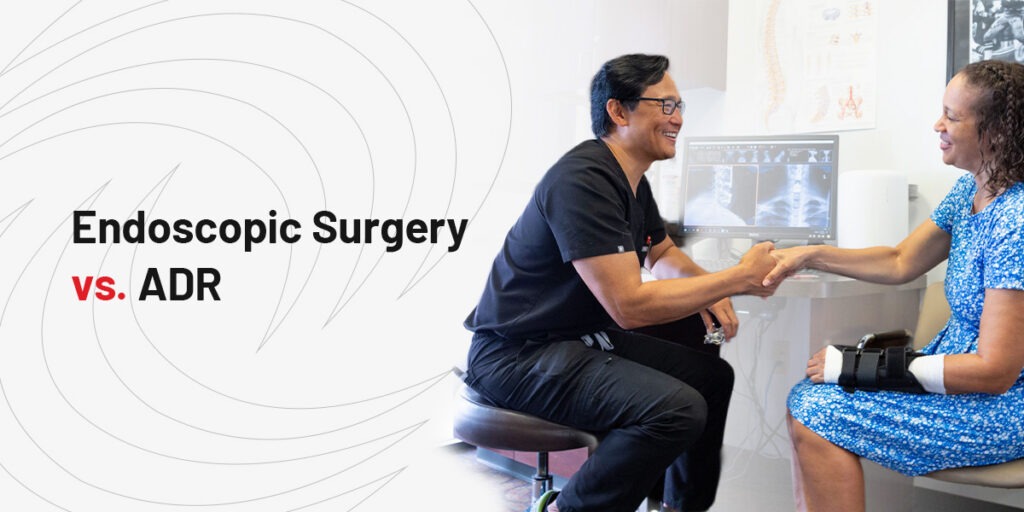
Chronic back or neck pain can be debilitating and affect our daily lives. When conservative treatments don’t provide relief, you might find yourself facing a critical decision. Do you pursue a procedure that cleans out damaged tissue, like endoscopic spine surgery, or opt for a reconstructive approach, like artificial disc replacement (ADR)?
While both surgeries can alleviate pain, they have different purposes, recovery times and outcomes. Read on to explore endoscopic surgery vs. ADR. We’ll explore how they work and compare recovery timeline, cost and other factors to help you make an informed decision for your lifestyle.
Endoscopic back surgery is a minimally invasive procedure that uses a ¼-inch incision and a high-definition camera called an endoscope to address spine issues. Guided by the camera and instruments passed through a tube to the targeted area, surgeons remove only offending tissue while leaving the healthy disc and stabilizing muscles intact.
Endoscopic spine surgery has been used to treat specific conditions primarily in the lumbar spine like spinal stenosis, disc degeneration, herniated discs, pinched nerves and sciatica. Compared to traditional open surgery, endoscopic techniques are minimally invasive, use smaller incisions and can lead to a faster recovery. Patients can often return home the same day as their procedure, and there’s less blood loss in the surgery, which can lower the risk of complications compared to traditional surgery.
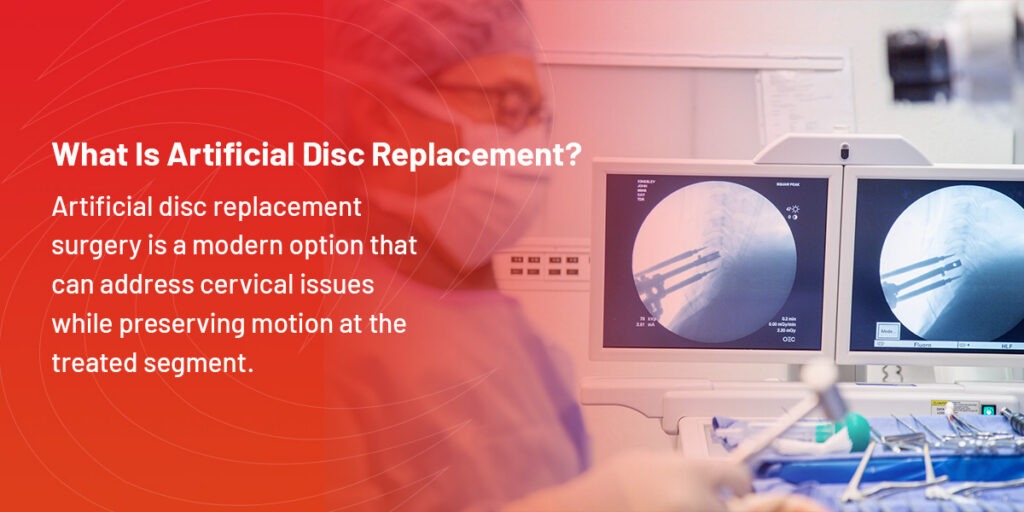
Artificial disc replacement surgery is a modern option that can address cervical and lumbar issues while preserving motion at the treated segment. Surgeons perform the surgery by removing the damaged disc and replacing it with a medical-grade device that mimics natural movement. The procedure can address conditions like degenerative disc disease, spinal stenosis and herniated discs.
More surgeons are adopting this new procedure to alleviate their patients’ symptoms while also preserving motion, unlike a spinal fusion. It may also prevent adjacent segment degeneration (ASD) after fusion, which is wear and tear on discs and facet joints below the fused segment that can lead to new symptoms and further surgery. ADR may prevent ASD since the surgery preserves motion, reducing stress on the discs and facet joints.
While endoscopic and ADR are both advanced, minimally invasive spine techniques, they have fundamentally different purposes. Learning how they differ in terms of mechanics, recovery and long-term outlook can help you make an informed choice.
Endoscopic surgery is a decompression procedure to remove what’s causing the pain, while ADR is a reconstruction procedure to replace the diseased disc and maintain motion.
Endoscopic surgery uses a camera to precisely remove only the material that’s causing pain, such as a bone spur or a fragment of a herniated disc, while leaving the healthy part of the disc intact. ADR involves replacing a damaged disc to preserve spine mobility. The goal is to restore height and movement where the natural disc has failed.
While both are minimally invasive, endoscopic surgery generally offers a slightly faster initial recovery and return to daily activities compared to ADR. Since no bones are fused or replaced, patients usually return to desk work within one to two weeks, and may enjoy full activity as early as three to six weeks.
Recovery from artificial disc replacement surgery can take slightly longer during the initial recovery period. While patients can often walk the same day, the body still needs time to heal around the new implant. Many people return to work and normal activities between two and six weeks.
Endoscopic surgery typically has a lower cost for the procedure itself since it’s a shorter, outpatient procedure without expensive hardware. ADR can have a higher price tag due to the cost of the implant and the complexity of the surgery. However, ADR may be seen as more cost-effective long-term than fusion, since it reduces the risk of needing future surgeries on adjacent levels.
Both surgeries can lead to excellent patient outcomes, including less pain. ADR can provide more long-term pain relief and outcomes than traditional fusion. It also has a lower risk of reoperation, with only 7.2% of patients needing another surgery, compared to 25.5% of fusion patients.
As for endoscopic surgery, the durability of the pain relief will depend on whether the underlying degeneration continues. The remaining natural disc must stay healthy to prevent further treatment. ADR is meant to last for years, but since it involves a mechanical implant, there can be a risk of wear and tear that would require future surgery to correct.
Research is critical when you’re trying to decide on the best treatment for your back or neck. From your symptoms and activity level to bone quality, here are a few factors that can influence the choice between endoscopic surgery and ADR:
Only a qualified spine specialist can determine the best option for your specific condition. At Desert Institute for Spine Care (DISC) in Phoenix, Arizona, our surgeons are leaders in minimally invasive spine techniques. We will perform a full evaluation to determine the best treatment for your needs, looking closely at your symptoms, health history and goals. From appointments to treatment to recovery, our priority is to provide the most comfortable experience possible and help you find relief.
Navigating spinal health decisions takes time. When it comes to ADR vs. endoscopic surgeries, there are many factors to weigh, from recovery timelines to costs and outcomes. DISC can support you throughout the process, performing a full evaluation to determine the most effective treatment for your needs and lifestyle. Our surgeons are recognized leaders in spine care, specializing in innovative, minimally invasive procedures to help you alleviate pain and restore your active lifestyle.
We can provide a diagnosis and guide you toward the best, most personalized solution for lasting relief. Schedule a consultation today to determine if ADR or endoscopic spine surgery is right for you.

Links:
https://www.sciatica.com/contact/