
Chronic back and neck pain and nerve compression can make many daily activities impossible. Fortunately, advanced medical interventions are here to help. Innovations in spinal surgery, particularly less invasive options, offer new hope for a return to enjoying life. Understanding the differences between a laminectomy, microdiscectomy and laminotomy is the first step.
Discover which procedure is recommended for specific conditions. Plus, gain the knowledge to partner with your surgeon in choosing the least invasive, most effective path to restoring your lifestyle.
A lumbar laminectomy removes part or all of the lamina — the bony arch that covers the spinal canal — to create more space for compressed spinal nerves. Surgeons may also remove bone spurs, thickened ligaments or other tissue pressing on nerves during the procedure.
This surgery typically addresses moderate to severe spinal stenosis compression. Your surgeon makes an incision over the affected vertebrae, moves muscles aside and removes the necessary bone. While traditional laminectomy requires a larger incision, minimally invasive techniques use smaller openings with specialized tools. Some procedures use microendoscopic approaches that represent the least invasive option.
Laminectomy addresses several conditions causing nerve compression:
Most patients stay in the hospital for 24 hours. You can typically walk the day after surgery, though you’ll need to avoid bending, lifting or twisting for several weeks.
You may meet with a physical therapist before your procedure to discuss rehabilitation. After surgery, you’ll follow an exercise plan in the hospital and at home. You might be able to resume light activity within a couple of days, guided by your surgeon. Full recovery typically takes three to four months for most patients.
A laminotomy removes only a small portion of the lamina rather than the entire structure. Surgeons create a window in the bone to access and decompress specific nerves while preserving most of the lamina.
This targeted approach maintains more spinal stability. The surgeon makes a smaller incision and removes just enough bone to relieve pressure on the affected nerve root. The procedure often takes less time than a full laminectomy and causes less disruption to surrounding tissue.
Deciding between a laminotomy and a laminectomy often depends on the extent of bone removal. A laminectomy removes the entire lamina on one or both sides of the vertebra. A laminotomy removes only a small section of bone — typically just the portion directly over the compressed nerve.
The smaller bone removal in laminotomy offers several advantages. It preserves more structural support, which can reduce instability risk. The procedure generally causes less postoperative pain and allows faster recovery. However, laminotomy works best for localized compression. If you have multilevel spinal stenosis or widespread narrowing, a laminectomy may be more appropriate.
A study comparing both procedures found similar pain relief and functional improvement scores. Patients who had a laminotomy showed slightly faster return to normal activities, though long-term outcomes were comparable.
Hospital stays after laminotomy are shorter — often same-day discharge. You can usually return to light activities within two to three weeks. A microdiscectomy often is performed in conjunction with a laminotomy.
Physical therapy helps restore strength and flexibility. Most people resume normal activities within six to eight weeks. The less invasive nature of laminotomy typically means less postoperative pain and faster mobility improvements compared to traditional laminectomy.
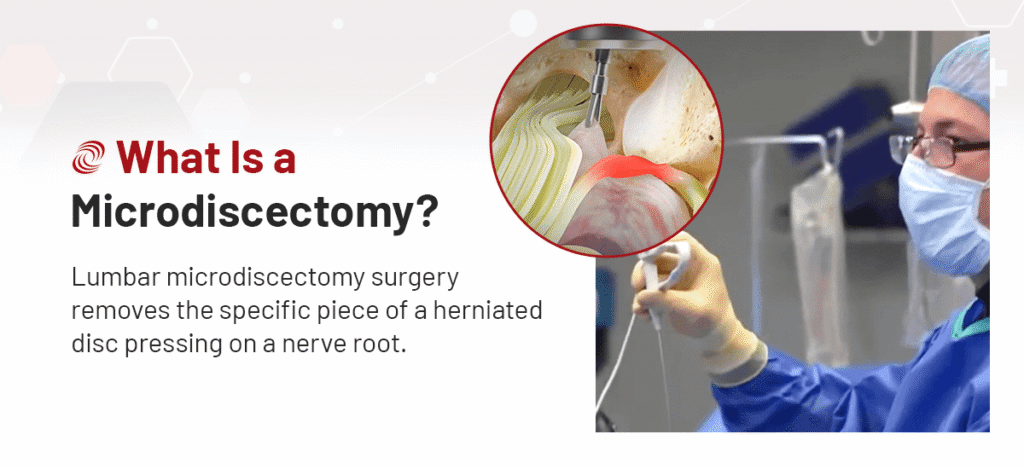
Lumbar microdiscectomy surgery In addition to a laminotomy—which relieves pressure by removing a small portion of bone to address spinal canal compression—a microdiscectomy is often performed through this same approach to directly treat disc-related nerve compression. This combined laminotomy and microdiscectomy technique allows the surgeon to access and remove herniated or bulging disc material that has protruded into the spinal canal, effectively decompressing the affected nerve while preserving surrounding structures.
Surgeons use an operating microscope or magnifying loupes for precision. A small incision of 1 inch allows access to the herniated disc. The surgeon removes only the herniated portion while leaving the healthy disc intact. This focused approach protects the surrounding structures and nerve tissue.
Microdiscectomy addresses nerve compression from disc problems:
Many patients go home the same day as surgery. The small incisions used in this minimally invasive approach result in shorter recovery times than with traditional open surgery.
During the first few weeks, avoid bending and prolonged sitting to allow your incision to heal properly. Physical therapy helps restore strength, improve range of motion and prevent future disc problems. Most people resume normal movement within two to four weeks, with full recovery taking approximately eight weeks.
Understanding the differences between a laminectomy, microdiscectomy and laminotomy helps you discuss the best approach with your surgeon:
| PROCEDURE | Laminectomy | Laminotomy | Microdiscectomy |
|---|---|---|---|
| Target | Removes lamina to decompress the spinal canal | Removes small portion of lamina for targeted decompression | Removes herniated disc material pressing on nerve |
| Best For | Spinal stenosis, bone spurs, pinched nerves, spinal tumors and degenerative disc disease | Localized nerve compression with mild to moderate stenosis | Sciatica, radiculopathy, cauda equina syndrome and recurrent disc herniation |
| Invasiveness | Can be minimally invasive or traditional open surgery | Minimally invasive with partial bone removal | Minimally invasive-same as laminotomy |
| Hospital Stay | Same-day discharge or short hospital stay following minimally invasive procedure — longer for open surgery | Usually same-day discharge | Usually same-day discharge |
| Recovery Time | 3-4 months for full recovery | 2-3 weeks for desk work or 6-8 weeks for normal physical activities | 2-3 weeks for desk work, or 6-8 weeks for physical jobs |
Your specific condition determines which procedure offers the best outcome. Age, overall health and severity of nerve compression also influence the decision.
Spine surgery is a significant decision. Getting a second opinion ensures you understand all your options and confirms the recommended approach fits your situation.
A second opinion consultation reviews your imaging studies, discusses your symptoms and evaluates whether surgery is the best next step. Some patients discover they’re candidates for less invasive procedures. Others gain confidence that their surgeon’s recommendation aligns with expert consensus.
Board-certified spine specialists can review your case and provide detailed explanations of expected outcomes, potential risks and alternative treatments. This perspective helps you move forward with clarity and confidence.
Desert Institute for Spine Care offers evaluation and treatment for spine conditions. Our board-certified physicians specialize in minimally invasive techniques that reduce recovery time and improve outcomes.
We provide detailed consultations to help you understand the differences between a laminectomy, microdiscectomy and laminotomy and determine which procedure may be right for you. Our team uses the latest surgical techniques and technology to deliver precise, effective care.
If you’re considering spine surgery, contact us today. We’ll review your case, answer your questions and create a personalized treatment plan focused on getting you back to the activities you love.

Linked sources: