

If you’re facing chronic neck or back pain that hasn’t responded to conservative treatment, you’ve likely heard your surgeon discuss two main surgical options — Artificial Disc Replacement (ADR) and spinal fusion. Both procedures have helped thousands of patients find relief, but the choice between them can feel overwhelming.
So why do leading spine surgeons recommend ADR over fusion? The answer lies in three critical factors — motion preservation, reduced risk of future surgery and faster recovery. Studies of more than 32,000 patients showed that ADR offers significantly lower all-cause five-year revision rates for appropriately selected candidates.
This guide explores the expert reasoning behind the ADR vs. spinal fusion debate, empowering you to make an informed choice.
When conservative treatments no longer provide relief, surgery becomes a consideration. Both artificial disc replacement and cervical fusion address the root cause of your pain by treating damaged or degenerated discs. However, they take fundamentally different approaches. Research both options thoroughly before choosing a procedure to understand how each aligns with your condition and lifestyle.
Spinal fusion eliminates motion at the affected segment by permanently joining two or more vertebrae. During the procedure, the surgeon removes the damaged disc, places a bone graft in the empty space and uses hardware to hold the vertebrae in position while they heal into a single, solid bone.
Fusion remains the gold standard for many spinal conditions, including multilevel disease, spinal instability and cases where the surrounding bone structure cannot support an artificial disc. While minimally invasive spine surgery techniques have made fusion less invasive with faster recovery, the procedure still results in permanent loss of motion at the treated level.
ADR involves removing the damaged disc and replacing it with a medical device designed to preserve motion at that spinal segment. The artificial disc mimics a healthy natural disc, allowing your spine to maintain flexibility and normal range of motion. Motion preservation has gained traction among spine surgeons who treat patients with single-level disc disease and healthy adjacent segments.
With both procedures defined, let’s examine the three clinical advantages that lead surgeons to recommend ADR vs. fusion procedures for appropriately selected patients.
The most significant advantage of artificial disc replacement over fusion is its ability to maintain the spine’s natural biomechanics. How your spine moves and ages depends on whether motion is preserved or eliminated.
A healthy spinal disc acts as a cushion and a pivot point, allowing you to bend, twist and move freely. An artificial disc is engineered to replicate this dual function. Advanced implants mimic the natural disc’s shock-absorbing properties while allowing controlled motion in all directions.
Preserving motion means you can continue activities like turning your head to check blind spots while driving, looking up at shelves or bending forward — movements that become restricted after fusion. For patients who want to maintain an active lifestyle, a thorough examination of the benefits of cervical ADR vs. fusion is essential for improving comfort and mobility.
When one segment of your spine is fused, the vertebrae above and below must compensate by moving more than they were designed to. Over time, the increased stress can accelerate wear on the adjacent discs.
While fusion relieves pain at the treated level, patients often notice stiffness during daily activities. The stability provided by fusion outweighs the loss of motion for many patients with complex spinal conditions.
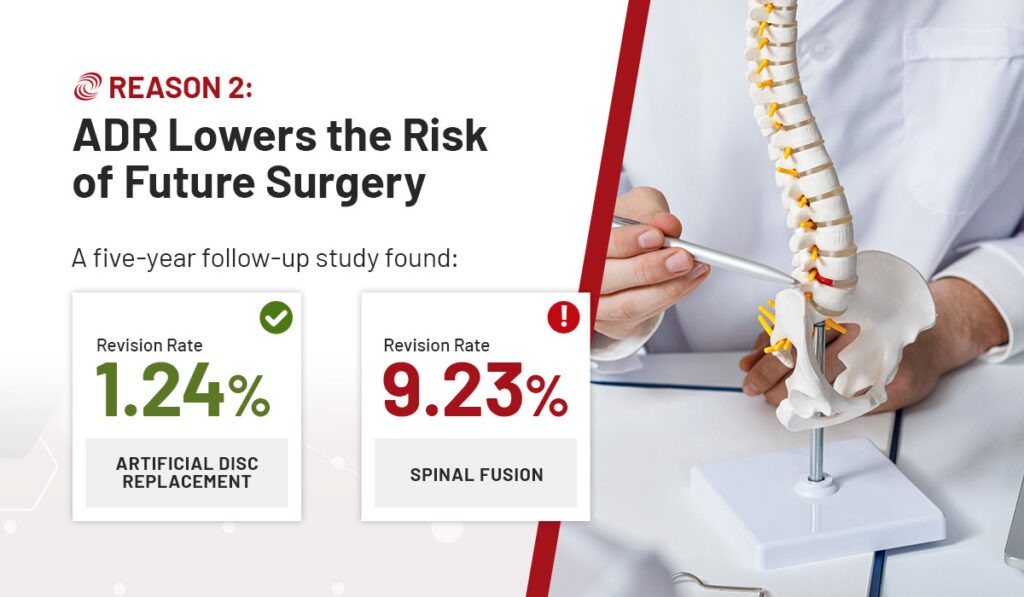
One of the most compelling reasons surgeons recommend artificial disc replacement vs. fusion for appropriate candidates is the significantly lower revision rate for ADR.
Adjacent Segment Disease (ASD) occurs when the discs neighboring a fused segment degenerate faster than they would naturally. Because fusion eliminates motion at one level, the segments above and below must work harder to maintain your spine’s flexibility. The added stress accelerates disc degeneration, sometimes requiring additional surgery years later.
The research comparing ADR and spinal fusion outcomes is striking. A five-year follow-up study found the all-cause revision rate for ADR was 1.24% compared to 9.23% for fusion, more than seven times lower. These findings are reinforced by another analysis showing that patients in the fusion group had a higher reoperation rate than those in the cervical ADR group — 4.6% vs. 1.5%.
Beyond preserving motion and reducing future surgery risk, ADR typically offers a more streamlined recovery process.
Fusion requires time for the bone graft to fully integrate and the vertebrae to become a solid unit, a process that can take several months. While spinal fusion can be performed using minimally invasive techniques that reduce tissue damage, the biological process of bone fusion cannot be rushed.
ADR patients don’t need to wait for bone healing. Once the surgical site has healed — typically within a few weeks — the artificial disc is fully functional. Recovery often translates to an earlier return to work, driving and low-impact activities.
When researchers track how patients feel after surgery by measuring pain levels, neck function and overall quality of life, ADR patients consistently report better outcomes. In one large FDA study, over 91% of patients who received an artificial disc achieved meaningful improvement compared to 74.6% of fusion patients. ADR patients also scored lower on the Neck Disability Index (NDI) than those who underwent total disc replacement.
Understanding the advantages of ADR is only part of the equation. An important question is which procedure is right for you? The answer begins with a thorough evaluation designed to match your specific condition, lifestyle and treatment goals to the most appropriate surgical approach.
Your journey begins with a comprehensive evaluation using advanced diagnostic tools and personalized pain mapping. Your evaluation includes:
Once your surgeon recommends the appropriate procedure, your path follows a clear timeline:
Now that you understand why some surgeons recommend ADR over fusion, you will want to choose a surgical team with the expertise needed to help improve your quality of life.
At Desert Institute for Spine Care (DISC), our board-certified, fellowship-trained surgeons are recognized leaders in minimally invasive and motion-preserving spine surgery. Our surgical specialists are the best at what they do, with expertise in technologies like the M6-C artificial disc.
If you’ve already been told you need surgery but want to explore all your options, DISC can give you a second opinion so you know you’re making the right choice for your condition and your lifestyle.
Whether you’re traveling from around the world or live in the greater Phoenix area, we’re here to guide you through your journey. Make an appointment at DISC today and take the first step toward restoring your active lifestyle.
Linked sources:


 By Joshua H. Abrams, D.O.