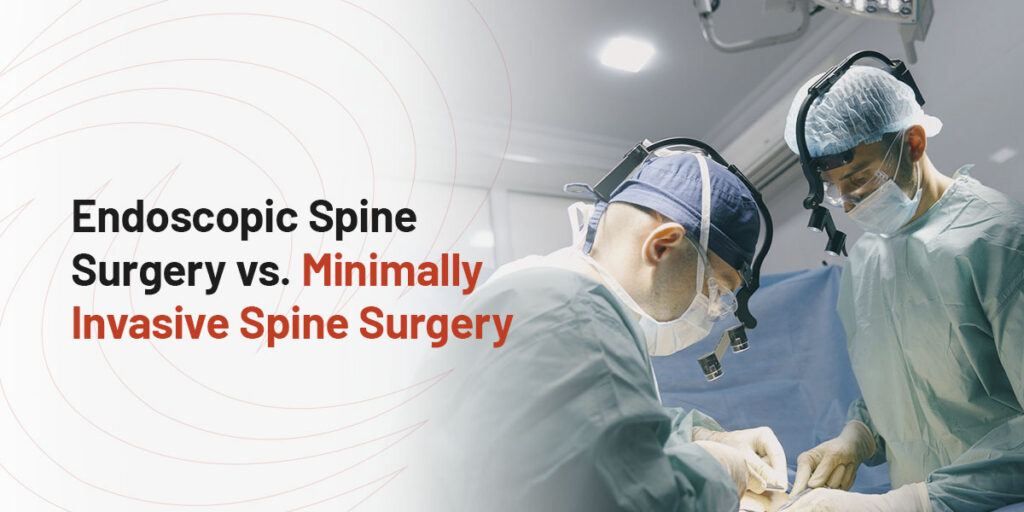
If you’re facing spine surgery, you’ve probably heard terms like “minimally invasive” and “endoscopic” used to describe surgical options. While both sound less intimidating than traditional open surgery, they’re not interchangeable.
Understanding the distinction between endoscopic spine surgery and minimally invasive spine surgery can help you identify the least invasive approach that effectively treats your condition. The differences will impact your recovery timeline, post-operative pain and return to daily life.
Minimally invasive spine surgery (MISS) represents a significant advancement over traditional open surgery. It is the bridge between conventional techniques and ultra-minimally invasive options.
During a MISS procedure, your surgeon makes an incision of around 1 inch or more and uses tubular retractors to gently dilate the muscle tissue rather than cutting through it. This approach allows access to the spine while reducing trauma to surrounding structures.
Next, the surgeon uses a microscope or surgical loupes positioned outside your body to visualize the surgical site through the tubular retractor. While this external magnification provides good visualization, the surgeon is essentially looking down a narrow tube at the spine.
MISS significantly reduces blood loss, complication rates and recovery times compared to traditional open surgery. This makes it a valuable option for many patients who need more than the most minimally invasive approach but want to avoid the extensive tissue disruption of open procedures.
Often referred to as the “least invasive” option, this technique uses an incision less than 1/4 inch — small enough to be covered by a Band-Aid. The defining feature is the endoscope itself — a thin tube equipped with a tiny, high-definition camera that’s inserted into the surgical site.
Unlike MISS, where the surgeon views the area externally through a microscope, the endoscope places the “eye” at the problem site. The camera transmits magnified, real-time images to a monitor. This gives your surgeon a close-up view of the nerves, disc material and surrounding anatomy.
Direct visualization allows precise targeting of the pain generator with specialized micro-instruments designed for endoscopic procedures.
For patients who are good candidates for endoscopic spine surgery, the benefits include dramatically reduced tissue trauma and faster return to normal activities.
While both approaches aim to reduce surgical trauma, four distinctions set them apart.
The size of your surgical incision directly affects scarring and cosmetic outcomes:
MISS: The 1-inch incision is typically closed with stitches.
Endoscopic: A 1/4-inch incision, the width of a pencil eraser, is often closed with a steri-strip — no stitches needed.
Result: Endoscopic spine surgery leaves minimal scarring that’s barely noticeable once healed.
How each technique handles muscle tissue influences your post-operative comfort:
MISS: Tubular retractors push muscle aside, creating temporary pressure and displacement that can cause post-operative soreness.
Endoscopic: Muscle fibers are dilated apart like a needle through fabric — no sustained pressure or retraction.
Result: There is less post-operative discomfort and faster functional recovery with endoscopic surgery.
The way your surgeon views the surgical site fundamentally changes the procedure:
MISS: An external microscope looks down through the tubular retractor, like viewing the bottom of a well through a tube.
Endoscopic: The camera travels directly to the nerve root, placing the “eye” at the problem site for superior visualization.
Result: Endoscopic surgery allows exceptional precision in navigating delicate anatomy and removing only problematic tissue.
Anesthesia type and recovery location vary between the two approaches:
MISS: Requires general anesthesia, and patients can often go home the same day after several hours of observation.
Endoscopic: Often performed under conscious sedation, allowing patient feedback during nerve stimulation. Patients typically leave within hours of surgery.
Result: Reduced anesthesia risk and faster discharge with endoscopic surgery.
Recovery experiences vary based on which technique your surgeon uses.
Patients who are good candidates for minimally invasive spine surgery and undergo MISS typically return to desk work within 4 to 6 weeks and resume more strenuous activities within 8 to 12 weeks.

Endoscopic spine surgery patients often leave the surgical center the same day and return to non-strenuous work within one to two weeks. Many resume driving within days and light exercise within two to three weeks. Your surgeon will provide personalized activity guidelines based on your specific procedure and condition.
MISS patients may need prescription pain medication for a longer duration due to greater tissue manipulation, though this is still significantly less than what traditional open surgery requires.
Post-operative pain correlates directly with tissue trauma. Because endoscopic surgery causes minimal muscle disruption, patients generally experience less pain and require fewer narcotic pain medications during recovery. Many manage discomfort with over-the-counter options alone.
Physical therapy (PT) plays an important role in both recoveries. Your rehabilitation program will be tailored to your procedure type. Endoscopic spine surgery patients often require less intensive PT protocols because natural muscle function has been better preserved.
Both endoscopic and minimally invasive spine surgery achieve similar pain relief, though endoscopic techniques showed more complete nerve decompression on post-surgical imaging. Another study reported similar findings, but endoscopic surgery resulted in a more complete opening of the spinal canal and nerve pathways on post-surgical imaging.
Your surgeon will assess your imaging studies, overall health, specific diagnosis and treatment goals to recommend the approach that offers the best outcome for your situation.
You may be an ideal candidate for endoscopic surgery if you have sharp, shooting pain that radiates down your arm or leg, and your symptoms match what your magnetic resonance imaging (MRI) shows. Your surgeon will also look for specific signs that conservative treatments such as physical therapy, medications or injections haven’t provided lasting relief after 6 to 12 weeks.
Endoscopic surgery works best for single-level herniated discs, spinal stenosis or nerve compression when you’re in good overall health and seeking the least invasive option available.
MISS becomes preferable when your condition needs more extensive surgical access. Multilevel spinal fusions, significant spinal instability or complex deformities may necessitate the larger working channel that MISS provides.
Patients with conditions too complex for endoscopic techniques but who still want to avoid traditional open surgery often benefit from this middle-ground approach that balances tissue preservation with surgical versatility.
Not all spine surgeons perform endoscopic procedures. The technique requires specialized training and equipment that many practices do not offer. If your surgeon performs only MISS or traditional open surgery, they may not offer endoscopic surgery as an option.
Getting a second opinion from a practice that offers the full spectrum of surgical approaches ensures you understand all your options before making this important decision.
At Desert Institute for Spine Care (DISC), we remain at the forefront of innovation — a legacy built by our founder, Dr. Anthony Yeung, who developed the first endoscopic spine instrumentation. We continue to advance these pioneering techniques so you can access the most effective, least invasive options available.
Because we offer the full spectrum of surgical approaches — from endoscopic procedures to minimally invasive and complex open surgeries — our recommendations are never one-size-fits-all. We evaluate your unique condition and guide you toward the approach that offers the best outcome for your specific needs.
Whether you’re seeking a first or second opinion, schedule a consultation today to explore your personalized path to enjoying life again.
Linked Sources: