
Receiving a diagnosis of spinal stenosis can feel overwhelming, especially when the conversation turns to surgery. Addressing a spine problem does not always mean undergoing a major spinal fusion — a procedure that involves permanently joining vertebrae together with screws and rods.
The thought of losing mobility or facing a long recovery sometimes causes people to delay necessary treatment. However, spinal stenosis without fusion is not only possible but the preferred treatment path for many patients. Learn why spinal stenosis surgery does not always require fusion, the benefits of non-fusion surgery and how to prepare for a conversation with your doctor about the best non-fusion options for you.
Spinal stenosis occurs when the open spaces around the spinal cord and exiting nerves within your spine narrow. This narrowing puts pressure on the spinal cord and the nerves that travel through the spine to your arms and legs. While it can happen in the neck, spinal stenosis is most common in the lower back. This is called lumbar spinal stenosis.
For many people, this pressure leads to specific, debilitating symptoms. You may experience heavy cramping in your legs when walking, known as neurogenic claudication. Others feel shooting pain, numbness or tingling that travels down the buttocks and into the feet. These symptoms often force patients to lean forward or sit down to find relief.
Physical therapy, anti-inflammatory medications and epidural steroid injections are effective for managing mild to moderate symptoms. However, if these nonsurgical methods fail to improve your quality of life after several months, surgery becomes a consideration. The goal of any spinal stenosis surgery is decompression. Simply put, the surgeon needs to open up the narrowed spaces to relieve the pressure on the trapped nerves.
While the goal of relieving pressure is always the same, the method used to achieve it can vary. Understanding the difference between decompression with fusion and decompression alone is important for making an informed decision.
Spinal fusion is a procedure designed to stabilize a painful vertebral segment and prevent motion. The surgeon decompresses the spinal canal and then to restore disc height, places bone graft material between two or more vertebrae, often securing them with metal plates, screws or rods. Over time, these vertebrae heal into a single, solid bone.
Fusion is often necessary when the spine is unstable. If a patient has a condition like spondylolisthesis, where one vertebra slips forward over another, or severe deformity, fusion provides the stability needed to prevent further slippage and pain.
For patients who have a stable spine, fusion is often unnecessary. In these cases, the surgeon performs a decompression alone procedure. This approach removes the bone spurs, thickened ligaments or herniated disc material that is pinching the nerves. The structural integrity of the spine remains intact, so no screws or rods are needed.
Common non-fusion procedures include:
Many procedures can be performed using minimally invasive or endoscopic techniques that reduce trauma to the body.
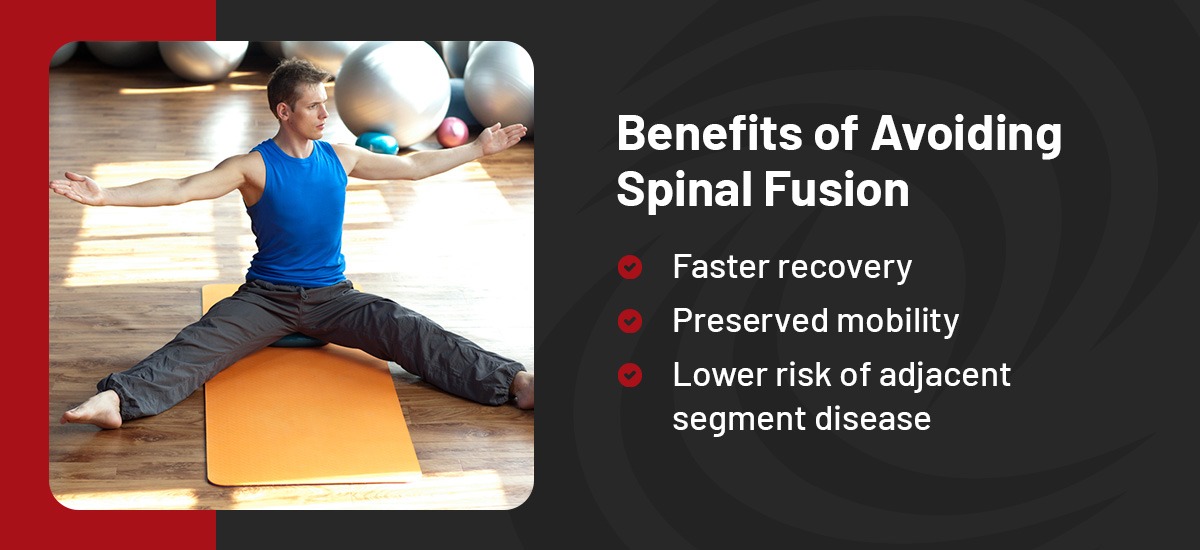
Choosing a decompression-alone approach has advantages for the right candidate. Because the procedure is less extensive, the impact on your body and your lifestyle is reduced in the following ways:
Defining success in spinal stenosis surgery depends on the patient’s unique diagnosis. The goal is always to match the least invasive and most effective solution to the specific cause of nerve compression. The choice between a decompression-alone procedure and a decompression with fusion hinges on level of spinal degeneration and spinal stability.
If the spinal column is stable and the main issue is nerve compression from bone spurs or ligament thickening, decompression-alone, like a laminectomy, is the gold standard. For these patients, success is measured by the relief of nerve-related symptoms.
Studies have shown that decompression surgery provides significant and lasting improvements in leg pain, numbness and walking ability for this group. The benefit is a highly effective surgery with a significantly lower impact, which includes shorter surgery, less blood loss and a faster recovery.
If a person has spinal stenosis combined with instability, like degenerative spondylolisthesis, simply decompressing the nerves may not be enough. The underlying instability can cause mechanical back pain and increase the patient’s risk of reoperation.
For this group, a laminectomy with fusion is often recommended. Adding fusion for unstable cases can lead to functional improvement and lower the need for future surgeries. The trade-off is a longer operation, a longer hospital stay and a higher risk of complications. Success here is defined by addressing both the nerve compression and the mechanical instability.
Ultimately, a successful outcome is achieved when the surgical plan correctly identifies and addresses the root cause of your pain. This is why the diagnostic phase is so critical. A surgeon’s recommendation for or against fusion is based on a careful analysis of your imaging and symptoms to determine if instability is a contributing factor.
Because there is no bone graft that needs to fuse two vertebral bodies together, restrictions are less severe than with fusion. Recovery is generally as follows:
Determining the right approach requires a careful evaluation of your specific anatomy. Surgeons look for specific criteria when recommending decompression alone:
Living with spinal stenosis does not mean you have to accept a life of limited mobility or resign yourself to major fusion surgery. For many people, a targeted decompression procedure offers the perfect balance of pain relief with a faster, easier recovery.
At Desert Institute for Spine Care (DISC), we specialize in the most advanced, ultra-minimally invasive techniques. Our surgeons are pioneers in endoscopic spine surgery, which allows for thorough decompression through incisions smaller than a dime. We believe in preserving your natural anatomy whenever possible and are dedicated to helping you return to the active life you love.
Schedule a consultation with one of our spine specialists to discuss alternatives to spinal fusion for spinal stenosis that may be just right for you.