

If you’re dealing with pain in both your back and hip and aren’t sure which one is the problem, you’re not alone. Often, the real issue is sitting higher up the spine. Spinal referred pain occurs in 17% to 84% of patients who experience low back pain. This means you might feel the pain radiating in the hip when the spine is actually the source.
When you know the source of your hip pain, you can start targeted treatment to help improve your quality of life.
Back and hip pain may share the same root cause, namely the spine. Understanding how the two are connected can help you recognize what’s actually happening in your body.
The lumbar spine, pelvis and hip are not separate systems. They form a single connected structure, so a problem in one area often shows up as pain in another. The sciatic nerve, the body’s largest nerve, travels from the bottom part of the spine through the buttocks and down each leg. Compression anywhere along this nerve’s path can produce hip and leg pain, regardless of where the irritation began.
Because the spine, pelvis and hip essentially function as one unit, irritation near the lower spine can easily translate into hip discomfort.
Referred pain is pain felt in a location different from where it actually originates. The brain can mislocate the source of a pain signal, which is why a spinal problem can feel exactly like a hip problem. This overlap is common. In fact, 53% to 57% of adults with persistent low back pain have also reported concurrent hip or thigh pain.
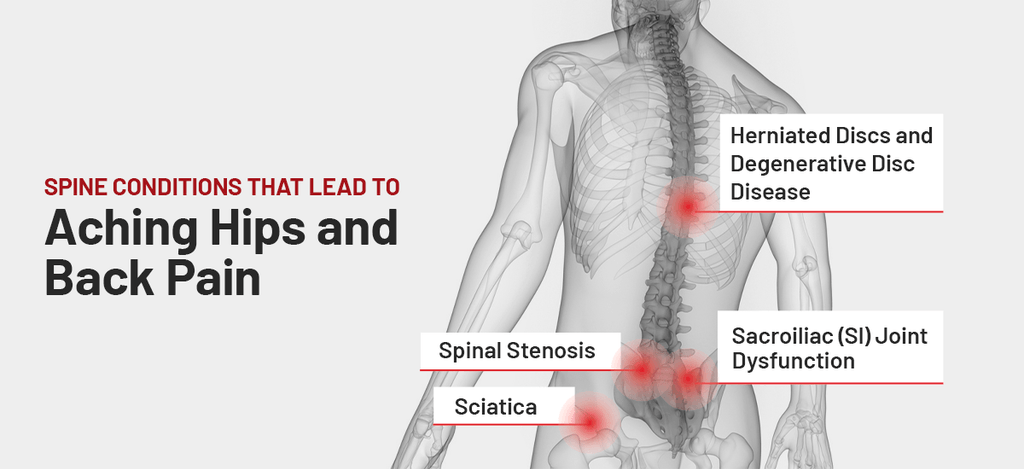
The reason your hips and back hurt could be due to one of several spinal conditions. Each involves the same general mechanism. Nerve irritation near the spine can radiate outward into the hip and leg.
Sciatica is among the most recognized spine conditions behind hip and leg pain, with up to 40% of people experiencing an episode during their lifetime. It’s when the sciatic nerve is compressed, radiating pain from the patient’s lower back into the hip, buttock and down the leg.
A well-known cause of sciatica is a herniated or bulging disc, though spinal stenosis is also a frequent cause in older patients.
If you’re experiencing pain in your hip and lower back on one side, sciatica may be the underlying cause. Sciatic pain typically affects one side of the body, following the nerve’s path from the back all the way to the leg.
Intervertebral discs are cushion-like joints positioned between the vertebrae. A disc can herniate, meaning the inner material starts coming out through a tear in the outer wall. When this happens, the bulging disc can press on a nerve root and send pain signals into the hip, buttock and leg.
Degenerative disc disease, the gradual wearing down of discs with age, can lead to the same nerve irritation over time. In both cases, a compromised disc puts pressure on the nerves, which can produce pain that feels far removed from the spine.
The sacroiliac joint is the junction between the lower spine and the pelvis. This joint sits directly at the crossroads of your back and hip. It’s a common cause of chronic low back pain, with estimates attributing 15% to 30% of cases to this joint specifically.
When this joint becomes inflamed, it can produce pain in the hip and buttocks. SI joint dysfunction is difficult to distinguish from sciatica, making it one of the trickier sources to pinpoint.
If you’re experiencing pain on one side, for example, in your left leg, along with low back discomfort, it’s worth asking your doctor whether the sacroiliac joint could be involved.
Spinal stenosis happens when the spinal canal narrows. This can put pressure on the nerves traveling to the hips and legs. When the nerves are compressed, they can produce radiating numbness, pain and weakness that patients often feel in the hip, buttock and leg.
The condition becomes more common with age. In patients over 50, lumbar spinal stenosis is among the most common causes of sciatica, often developing gradually.
Because the spine and hip share anatomy and nerve pathways, pinpointing the exact source of pain can be genuinely difficult. It’s best to talk to a doctor about persistent pain, since they can look for specific signs that point toward the spine or the hip joint itself.
A doctor may look for several signs that the pain is coming from the spine, including:
They may also check for signs that the pain could be from the hip joint itself, such as the following:
What makes diagnosis more complicated is that some patients have both a spine issue and a hip issue. When one part of the core, lower back or hips breaks down, compensatory changes in the adjoining structure can lead to pain in both areas. Because diagnosis is complicated, seeing a specialist is often the clearest path to an answer.
Many specialists have helped patients find relief from hip pain that traces back to the spine, but knowing when to find help matters. It’s best to see a specialist if back and hip pain persists beyond a week without improvement or is severe.
You should also see a doctor if the pain does any of the following:
When you need to see a specialist, look for a provider who offers a comprehensive diagnostic process rather than a one-size-fits-all approach.
When back and hip pain trace back to the spine, Desert Institute for Spine Care (DISC) offers a clear path toward answers. Through Personalized Pain Mapping, DISC’s board-certified, fellowship-trained surgeons use comprehensive evaluation and testing to pinpoint the exact source of pain. They replace guesswork with a diagnosis and a treatment plan tailored to the individual patient.
From there, care spans the full spectrum, from conservative management to ultra-minimally invasive spine surgery, with DISC surgeons always recommending the least invasive option first. For patients ready to understand what’s really behind their pain, contact DISC to schedule an evaluation.



 By Mark J. Wang, M.D.