
For Canadians living with chronic back or neck pain, sciatica, weakness, numbness, or limited mobility, every day can become a challenge. Pain can interfere with your ability to work, stay active, enjoy time with family, and simply live the life you want. When conditions such as a herniated disc, sciatica, or spinal stenosis aren’t improving, the next step may seem clear: get answers and find the right treatment. But for many Canadians, the biggest challenge isn’t knowing that they need help—it’s how long they may have to wait to receive it.
According to the Fraser Institute’s Waiting Your Turn: Wait Times for Health Care in Canada, 2025 report highlights the challenge of specialty medical care access across Canada. The recent survey describes the median wait time from referral by a general practitioner to treatment by a neurosurgeon to be 49.9 weeks and orthopedic surgeon 48.6.
You may have to wait for treatment-but you don’t have to wait to better understand your diagnosis and treatment options
Across all treatments Canadians waited a median of 28.6 weeks from GP referral to treatment—including 15.3 weeks to see a specialist and another 13.3 weeks to receive treatment. That is 208% longer than the 9.3-week median reported in 1993, highlighting how significantly healthcare wait times have increased over the past three decades.
For patients with spine conditions, the specialty-specific numbers are drastically higher. Certain spinal disorders may ultimately be evaluated and treated by either a neurosurgeon or an orthopedic spine surgeon, depending on the condition and individual patient. In the Fraser Institute’s 2025 report, neurosurgery and orthopedic surgery had the longest reported median referral-to-treatment wait times of the medical specialties surveyed.
The reported median wait for neurosurgery was 49.9 weeks—including 39.7 weeks from GP referral to the neurosurgeon consultation and another 10.1 weeks from the specialist visit to treatment. For orthopedic surgery, the total reported wait was 48.6 weeks, consisting of 21.3 weeks from GP referral to the orthopedic surgeon consultation and another 27.2 weeks from consultation to treatment.
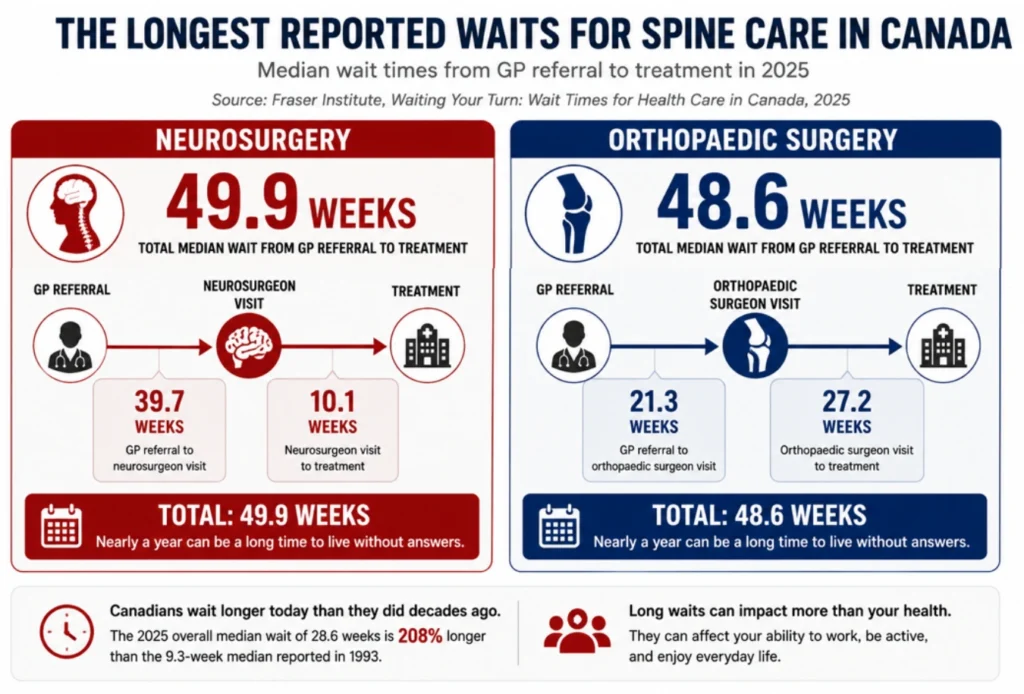
For someone struggling with a painful spine condition, nearly a year can be a long time to live without answers or a treatment plan. While these national median wait times do not represent every patient’s individual experience, they illustrate why some Canadians may choose to seek an additional spine specialist opinion while continuing to pursue care at home.
For patients with persistent neck or back pain, sciatica, weakness, numbness, or other neurological symptoms, an MRI can be an important part of evaluating the spine. MRI provides detailed images of the discs, nerves, spinal canal and surrounding structures, helping a spine specialist determine whether conditions such as a herniated disc, spinal stenosis or nerve compression may be contributing to a patient’s symptoms. For neurosurgeons and orthopedic spine surgeons, having current imaging can be an important part of establishing a diagnosis and determining whether surgery or another treatment may be appropriate.
Accessing that imaging, however, can add another delay to the patient’s journey. According to the Fraser Institute’s Waiting Your Turn: Wait Times for Health Care in Canada, 2025, Canadians experienced a reported median wait of 18.1 weeks for an MRI, compared with 8.8 weeks for a CT scan. For a patient who needs an MRI as part of the diagnostic process, that wait may occur alongside other delays in obtaining specialist evaluation and treatment. This is particularly noteworthy when the same report found median referral-to-treatment waits of 49.9 weeks for neurosurgery and 48.6 weeks for orthopedic surgery.
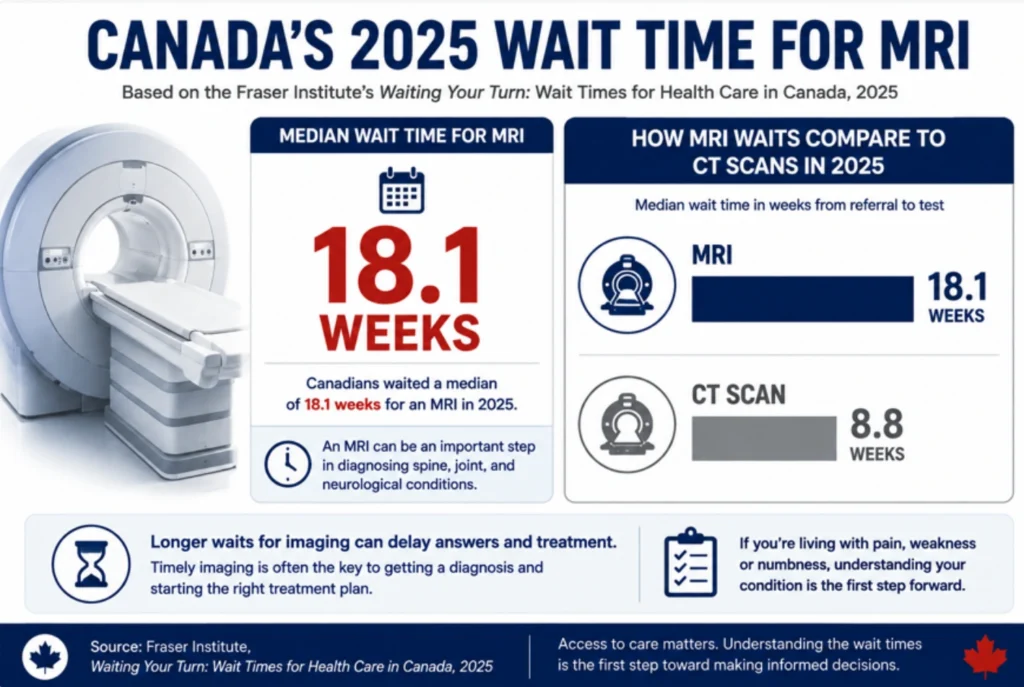
For Canadians already experiencing prolonged spine symptoms, obtaining a current MRI can also make it possible to seek an additional expert opinion. Patients who have recent imaging may be able to have those images reviewed through a Virtual Spine Second Opinion, helping them better understand their diagnosis and potential treatment options while they continue navigating care at home.
For someone living with a painful spine condition, waiting for answers or treatment can affect much more than the pain itself. Persistent back or neck pain, sciatica, numbness, weakness, or limited mobility can make it difficult to work, sleep, walk, exercise, travel, and enjoy time with family and friends. The World Health Organization identifies low back pain as the leading cause of disability worldwide, affecting an estimated 619 million people in 2020, and recognizes its impact on mobility, work, quality of life, and participation in everyday activities.
Long waits can also carry a financial cost. The Fraser Institute estimated that approximately 1.39 million Canadians were waiting for medically necessary treatment in 2025, resulting in more than $4.2 billion in lost wages and productivity—about $3,043 per patient waiting. For someone whose spine condition is keeping them from working or doing a physically demanding job, months of waiting can mean more than discomfort. It can mean lost income, missed activities, changes in family life, and putting parts of life on hold while waiting for a diagnosis or treatment plan.
The impact of waiting is different for every patient, and waiting does not necessarily mean a spinal condition will worsen or cause permanent damage. The significance depends on the diagnosis, severity of symptoms, neurological findings, and individual circumstances. However, progressive muscle weakness, new bowel or bladder dysfunction, numbness in the groin or saddle area, or rapidly worsening neurological symptoms should not wait for a routine appointment or second opinion and require prompt medical evaluation. For patients with persistent but stable symptoms, a second opinion can provide an opportunity to better understand the diagnosis and available treatment options while navigating the next steps in their care.
For many Canadian patients facing long wait times, you do not have to simply choose between waiting for care or immediately travel to the United States for consultation or spine surgery. There is another option that can offer valuable information, from home through a Virtual Second Opinion.
A Virtual Second Opinion allows an expert spine surgeon to review your MRI, and symptoms and offer a diagnosis and possible treatment or surgery recommendations. This consultation can help clarify what is causing your pain, is surgery appropriate, and how soon you could be seen in Phoenix, Arizona. In many cases, patients may be offered a less-invasive surgical procedure. The goal is not to rush patients into surgery but to give them greater confidence and clarity about their condition and the choices available to them while they continue to wait and navigate the Canadian Healthcare system.

If you’ve been told you may need spine surgery—especially a major procedure such as spinal fusion—a second opinion can help confirm the diagnosis, review your MRI, and determine whether the recommended treatment makes sense for your condition.
A second opinion may also identify less-invasive options, including endoscopic or minimally invasive surgery, artificial disc replacement, or motion-preserving procedures. Canadian patients can start from home with a current MRI and meet virtually with a DISC spine surgeon to discuss their diagnosis, treatment options, and next steps before deciding whether travel to Phoenix is right for them.
James, a powerline technician from Edmonton, Canada, loved his work—but a painful herniated disc forced him off the job and without pay. Searching for answers, he found the Desert Institute for Spine Care (DISC) and requested a Virtual Second Opinion. Within days, he met Dr. Christopher Yeung via video visit. Within 3 weeks, he had surgery. And just 8 weeks later, James was back on modified duty with full pay—providing for his family again.
A Virtual Second Opinion with a DISC spine surgeon is $700 USD.
The fee includes a review of your current MRI and relevant medical records, a virtual consultation with a DISC spine surgeon, discussion of your diagnosis and treatment options, time to ask questions, and a written summary of the surgeon’s second opinion. The goal is to help you better understand your condition and available options before making decisions about travel or treatment.
Start from home. Travel only if treatment at DISC is right for you.
Can a Canadian get a second Opinion from a US spine surgeon? Yes, many US spine surgeons are available for consultation, with wait times of a month or two and few have an actual virtual consultation program, such as Desert Institute for Spine Surgery.
Can a Canadian get a second opinion from a US spine surgeon. Yes, but one would have to schedule with a spine surgeon and then fly into see them. If surgery is offered, fly back home to Canada only to return a month or two later. DISC offers virtual access within a few days from the comfort of your home.
Do you have to travel to Phoenix for my second opinion? No, you can be seen virtually once you have uploaded your MRI, been interviewed by our second opinion specialist, and paid your $700 consultation fee. You only need travel to Phoenix if you are a surgical candidate. This virtual process saves you valuable time and money.
How recent does my MRI need to be? Your MRI is preferred to be less than one year old.
How much does the DISC Virtual Second Opinion Cost? The cost of a virtual second opinion is $700 which includes a virtual meeting with one of our expert spine surgeons, a review of your MRI, symptoms, diagnosis, treatment recommendations, as well as time to answer your questions and concerns.
Can DISC tell me whether I really need spinal fusion? After a thorough review of your condition and MRI, our surgeon can either confirm a spinal fusion when appropriate or in many cases suggest alternatives or less-invasive surgical options to a spinal fusion.
What happens if DISC surgeon recommends Surgery? If you agree with our surgeon’s plan and want to move forward, he will issue a surgery order. Once the surgery order is out then our surgery scheduler and front office will reach out to you to schedule your surgery.
How quickly can I receive a Virtual Second Opinion? Once we have your current MRI (within 1 year) and your consultation fee of $700 we can usually schedule your virtual appointment within 3 days.
What types of spine conditions does DISC evaluate? DISC treats everything from common back and neck pain to complex spine conditions—including herniated discs, sciatica, spinal stenosis, degenerative disc disease, pinched nerves, scoliosis, spondylolisthesis, and failed back surgery syndrome.
What does spine surgery in Phoenix cost for Canadian patients? Surgical costs depend on the procedure recommended. For example, endoscopic spine surgery at DISC typically ranges from $10,000–$15,000 USD. More complex procedures may cost more. Canadian patients receive transparent, bundled cash pricing before making the decision to travel to Phoenix, so there are no surprises.
Canadian patients may face waits of 49.9 weeks for neurosurgery, 48.6 weeks for orthopaedic surgery, and 28.6 weeks overall. You may have to wait for treatment—but you don’t have to wait for another opinion.
Start from home with a $700 USD DISC Virtual Second Opinion. Submit your MRI, meet virtually with a DISC spine surgeon, and better understand your diagnosis and treatment options before deciding whether travel to Phoenix makes sense.
You’ve Waited Long Enough for Answers.
Request Your Virtual Second Opinion


 By
By