
If you’ve had artificial disc replacement (ADR) surgery, you might be wondering when you’ll be able to return to your sport. You may have searched online for a clear timeline only to find vague answers or conflicting advice.
You don’t want to push too hard too soon, but you also don’t want to lose the competitive edge you’ve worked years to build. Athletes returning to sport after ADR need specific, phase-by-phase guidance. This page breaks down the return-to-sport timeline for both cervical and lumbar artificial disc replacement, the restrictions you’ll face and the factors that influence how soon you can compete again.
Artificial disc replacement surgery replaces a damaged spinal disc with a prosthetic designed to preserve natural movement. Unlike spinal fusion, which permanently locks vertebrae together, ADR maintains mobility at the treated level. This distinction matters for athletes, as preserved motion reduces stress on neighboring discs and supports a faster return to activity.
Experts recommend returning to play at approximately 4 to 6 weeks or more for cervical ADR patients, depending on the sport and competition level. On average, young athletes with lumbar ADR are shown to achieve peak performance after 5.2 months.
ADR patients typically resume normal activities faster than those who undergo spinal fusion. Ultimately, your timeline will depend on your type of surgery, sport requirements and rehabilitation protocols.
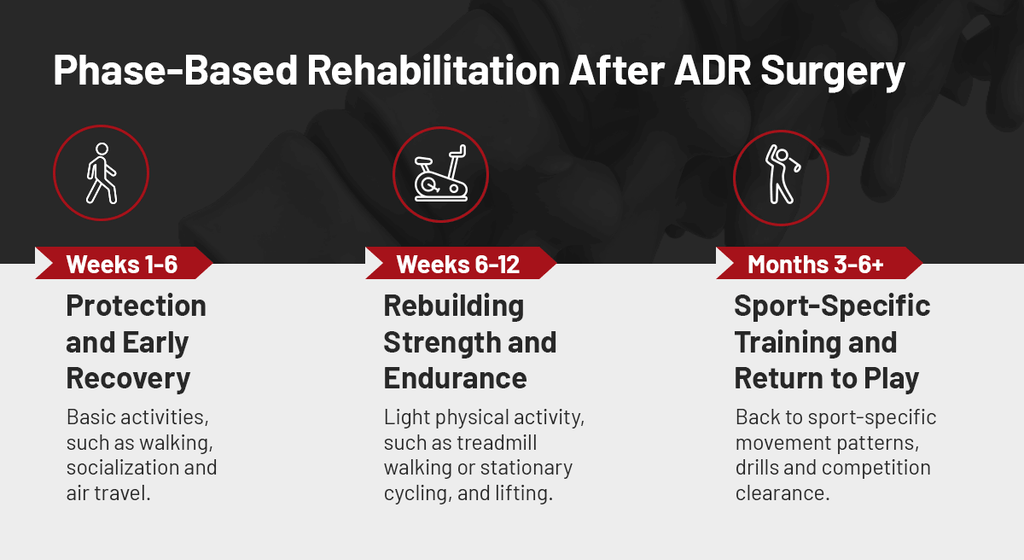
Athletes with artificial disc replacement have a phased recovery, with advancement depending on clinical milestones. Your surgeon and physical therapist will guide care decisions based on your individual progress.
During the first two weeks, you can expect to return to basic activities, such as walking, socialization and air travel. This first phase focuses on wound healing, pain management and surgical site protection. Physical therapy usually begins within this period to support strength and mobility.
At this point, walking programs should promote circulation and prevent stiffness. Core muscle activation exercises can help restore foundational strength. These exercises target the transverse abdominis, multifidi and glutes for lumbar ADR, or cervical and scapulothoracic stabilizers for cervical ADR.
Lifting restrictions also apply during this phase. You’ll want to limit physical activity, such as bending, twisting or lifting heavy objects.
This phase is often when athletes start to feel like themselves again. Discipline still matters, but the scope of permitted activity expands significantly. Light physical activity is typically cleared at four to six weeks for cervical arthroplasty. Sport-specific conditioning may also begin around six weeks with an individualized assessment.
Aerobic conditioning progresses to include light physical activity, such as treadmill walking or stationary cycling, and lifting tolerance increases incrementally.
This phase is when athletes generally expect to return to play. You’ll transition from general conditioning back to sport-specific movement patterns, drills and competition clearance. Keep in mind that “cleared to train” and “cleared to compete” are two different milestones. Ultimately, your surgeon’s sign-off will determine readiness.
Athletes in contact sports may face additional evaluation criteria before full clearance. Your cervical artificial disc replacement recovery time depends on meeting functional benchmarks throughout this phase.
Individual evaluation ultimately determines your healing timeline, though here are restricted activities for total disc arthroplasty and when they typically lift:
Walking: You may begin walking immediately after surgery.
Physical therapy: Your surgeon might recommend therapeutic exercise after two weeks.
Bending and rotating: Avoid lumbar spine flexion, side bending and rotation for at least six weeks.
Swimming: Your surgeon may clear you to begin swimming once your wound has healed, typically after six weeks.
Lifting: Avoid physical work or any lifting for 6 to 12 weeks.
Sports: Do not engage in high-risk activities and competitive sports for at least six months or until cleared by your doctor.
Tobacco use: Your provider may ask you to quit tobacco products at this time, as they can interfere with healing.
These guidelines are based on expert consensus frameworks for activity progression. If you have questions about ADR surgery restrictions specific to your case, consult your surgeon.
High-contact sports, such as football, hockey, rugby and martial arts, may require more time to heal before you can return to play. In one comparative study, two professional martial arts participants successfully returned to play after cervical disc arthroplasty. They were able to engage in non-contact sports after four weeks and full-contact sports within six months.
The type of sport matters for both timeline and evaluation criteria. A spine surgeon familiar with athletic demands should be involved in your clearance decision, particularly if you’re returning to sports after spine surgery in a contact or collision discipline.
No universal timeline exists, as multiple variables affect recovery:
Your activity level before surgery, commitment to rehabilitation and specific sport all play a role in when you’ll be cleared to compete. Both lumbar artificial disc replacement and cervical artificial disc replacement carry unique recovery considerations.
If you’re a parent or guardian of an adolescent athlete, you may have heard of a pars fracture, or spondylolysis. This refers to a stress fracture of the pars interarticularis — a small bony structure in the lower back. Spondylolysis affects less than 10% of Americans each year. It is most common in kids and teens, particularly those in gymnastics, football and other contact-heavy sports.
Spondylolysis is fundamentally different from disc degeneration or herniation, the conditions that typically lead to ADR. In most cases, ADR is not the indicated treatment in adolescent athletes. The approach is typically conservative, involving bracing, activity modification and physical therapy. Direct pars repair — not ADR — is the indicated approach when surgery is required.
Speak with your provider about recovery times. People recovering from spondylolysis generally require a few weeks to several months of treatment before resuming sports. At DISC, we offer expert consultation to help families understand when ADR is the right choice and when other approaches, including motion preservation spine surgery, may be more appropriate. If you’re a parent of a young athlete dealing with a complex spine condition like spondylolysis, our team is here to answer your questions and explore the right treatment path.
Whether you’ve already undergone or are considering artificial disc replacement, Desert Institute for Spine Care is here to help. Our board-certified surgeons are ready to provide the personalized guidance you need. We understand the unique demands athletes face and can help you navigate your return-to-sport timeline with confidence.
Schedule your consultation today to take the next step toward returning to the activities you love.
Linked sources:
https://www.sciatica.com/spine-treatments/artificial-disc-replacement-surgery/
https://www.sciatica.com/blog/why-some-surgeons-recommend-adr-over-fusion/
https://my.clevelandclinic.org/health/treatments/16758-cervical-artificial-disk-replacement
https://www.sciatica.com/blog/cervical-artificial-disc-replacement-recovery-time/
https://www.sciencedirect.com/science/article/pii/S266654842500040X
https://my.clevelandclinic.org/health/treatments/16758-cervical-artificial-disk-replacement
https://www.sciatica.com/spine-treatments/cervical-artificial-disc-replacement/
https://www.sciatica.com/blog/going-back-to-sports-after-spine-surgery/
https://my.clevelandclinic.org/health/diseases/10303-spondylolysis


 By
By