
 A study found that more than one-third of recreational golfers reported lower back pain in the preceding week, so the ache after 18 holes is something many golfers share. Lower back pain from golf does not have to mean stepping away from the game for good. By understanding why it happens, you can take the first step toward a clear path back to the course.
Golf is often seen as a low-impact sport, but the swing explains how golf can cause back pain. Each swing requires the lumbar spine to absorb rotational force that the thoracic spine should share, and peak compressive force on the lower back can reach up to approximately eight times body weight. A typical round repeats this across 70-plus swings, so the follow-through phase, when the body decelerates fastest, tends to be the highest-risk moment.
Several conditions can develop from this repeated stress, though not every ache signals something serious. Muscle strains and sprains are the most common and recoverable, often easing within days to weeks. Other golfers experience lower back pain tied to a herniated disc, facet joint inflammation or degenerative disc disease, each responding differently to treatment.
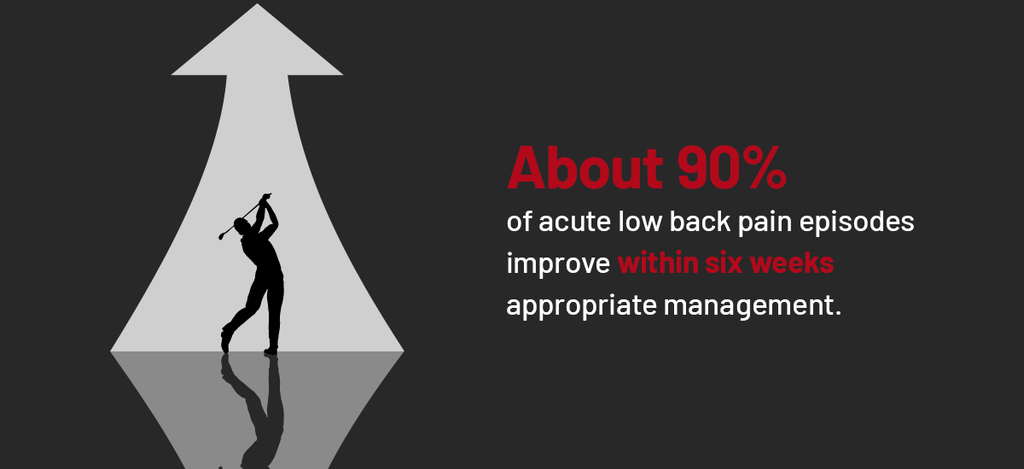
Recovering from golf-related back pain requires you to adjust how you play and to do the targeted rehab work your spine needs. About 90% of acute low back pain episodes improve within six weeks with appropriate management, so the approach matters as much as the timeline.
For some golfers, the answer is modified activity rather than stopping entirely. Prolonged rest is a common instinct, but it can slow recovery and weaken supporting muscles. Gentle, continued movement supports healing, so the goal is staying active at a lower intensity.
In practice, you could modify your game in a few ways, such as:
Reducing your swing count.
Choosing shorter clubs.
Keeping tempo easy.
Avoiding full drives.
The same principle applies off the course, since walking and light stretching support recovery while extended rest does not. Worsening symptoms during or after a session signal it is time to scale back.
Trunk stabilization exercises like planks, bridges and bird dogs strengthen the core muscles that support the lumbar spine, alongside glute and hip strengthening that shares the load your lower back would otherwise carry alone. In one randomized controlled trial in amateur golfers, those who followed a trunk stabilization and lower extremity strengthening program reduced pain and disability more than those doing general swing exercises and stretching. Core stabilization exercises are considered an evidence-based approach for this reason.
Try these three stretches that target the hips and spine:
Corner-assisted half-kneeling hip flexor stretch: Kneel on one leg while keeping the other foot flat on the ground in front of you, both knees bent at 90 degrees. Engage your core, gently tuck your pelvis and lean forward to stretch the hip flexor of your kneeling leg. The “corner-assisted” aspect typically involves using a corner for support or to deepen the stretch by pressing into it.
90-90 peel: Sit on the floor with both legs bent at 90-degree angles, one leg externally rotated in front of you and the other internally rotated to your side. From this position, pivot on your heels to rotate your legs and switch sides, maintaining the 90-degree angles at your knees and hips.
You could do these lying-down and kneeling stretches from home before you head to the golf course, or at an on-site gym if one is available at your club. At the course, you could try standing options, like trunk rotations with a club across your shoulders, hip hinges and slow half-swing rehearsals before teeing off.
Returning to golf works best as a structured process. Take your time to feel good and rebuild strength rather than rushing back to full rounds and drives.
These questions offer an honest self-assessment to help you decide if you should play golf with lower back pain:
Timelines vary by condition, since sprains and strains can resolve in days to weeks, while a herniated disc may take several months to fully recover.
Once you feel ready, a graduated progression protects the progress you have already made:
Pay attention to pain during each session and the morning after, since next-day stiffness is an indicator to scale back. A high-volume range session can place more stress on the spine than a round on course, since it removes natural rest periods, so ball count still matters at that step. Use a warm-up routine before every session and continue strength training two to three times weekly for glutes, hips and core after returning to play.
Lingering stiffness usually means staying at your current step longer, not starting over. Start at a reduced intensity and gradually build volume before speed.
Most golf-related back pain responds well to activity modification and rehab, but certain signs mean it’s time to see a professional:
Working through golf-related back pain and returning to your game takes patience, and a structured approach makes it manageable. When self-directed recovery does not bring the improvement you want, expert evaluation can identify what’s driving the pain.
Desert Institute for Spine Care (DISC) brings board-certified, fellowship-trained spine surgeons with a collective 50 years of patient care experience to golfers managing back pain. DISC’s approach spans nonsurgical treatments through minimally invasive procedures, including the least invasive endoscopic techniques. Our doctors make recommendations based on the root cause of your pain.
Our aim is to reduce your back pain and improve comfort, mobility and function. Make an appointment at DISC to get started.



 By Joshua H. Abrams, D.O.