

When back pain strikes, you might feel the urge to search for quick answers. It can feel tempting to describe your symptoms to ChatGPT and see if it can diagnose back pain — after all, it’s free, immediate and requires no appointment. But relying on artificial intelligence (AI) for something as complex as spinal health comes with many risks.
While AI tools can provide general information, they cannot replace the clinical expertise of a spine specialist. The convenience of a chatbot comes at the cost of accuracy. Knowing what AI can and can’t do when it comes to diagnosing back pain will help you make informed decisions about your health.
AI cannot diagnose back pain. The spine is one of the most complex structures in the human body, with dozens of potential pain generators ranging from muscle strains to herniated discs to nerve compression. Relying on an algorithm to identify the source of your pain can be both inaccurate and unreliable.
AI models like ChatGPT process text based on patterns in their training data, but they lack the clinical judgment, diagnostic tools and hands-on evaluation that spine specialists use to reach accurate conclusions. Federal oversight bodies have identified significant challenges with AI in healthcare, including algorithm bias, lack of transparency in decision-making and unresolved questions about liability when AI-generated advice leads to harm. These issues make AI unsuitable for diagnosing medical conditions, especially those as nuanced and variable as spinal disorders.
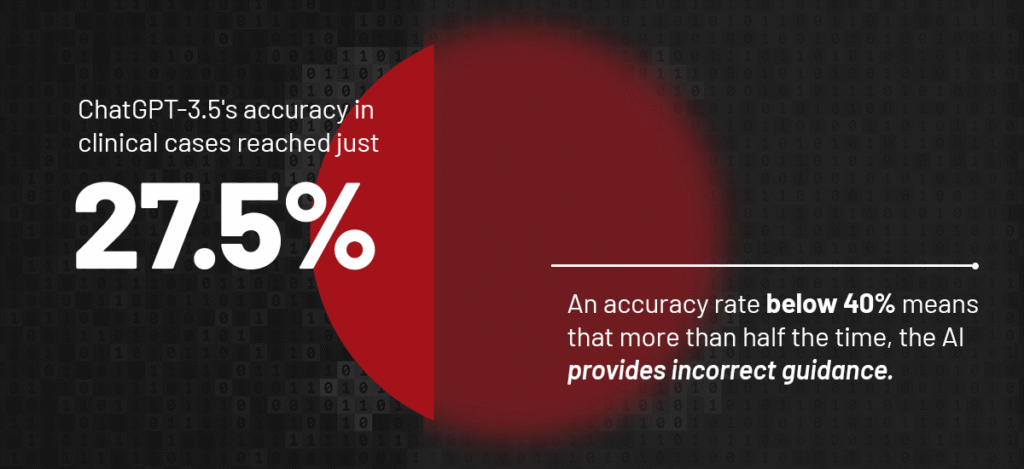
AI can be very inaccurate for medical diagnosis. In a 2023 study published in the Journal of the American Medical Association, GPT-4’s diagnostic accuracy was correct in only 39% of complex clinical cases. A 2024 study in PLOS Digital Health found ChatGPT-3.5’s accuracy in clinical cases reached just 27.5%.
An accuracy rate below 40% means that more than half the time, the AI provides incorrect guidance. ChatGPT may provide information that sounds confident but lacks clinical verification. The models work from text patterns alone — they can’t ask clarifying questions, observe physical signs or request additional tests that would help a physician narrow down the true diagnosis.
Another issue is AI hallucinations, in which the model generates incorrect information and presents it as fact. When using AI for medical diagnosis, the model can’t verify its own outputs against real-world clinical standards. It might confidently suggest a diagnosis or treatment plan that has no basis in your actual condition. For patients seeking clarity about back pain and turning to AI for answers, this could create an illusion of certainty where false information appears credible.
Understanding why AI models fail where specialists succeed requires examining the practical, physical realities of medicine that an algorithm cannot replicate.
A spine specialist gathers essential diagnostic information during a physical exam that no AI can access. Your doctor assesses your range of motion, tests your reflexes, evaluates muscle strength and pinpoints the exact location and nature of your pain through palpation and movement tests. These findings often reveal whether your pain originates from a muscular issue, a joint problem or nerve involvement — distinctions that directly influence treatment decisions.
An AI tool processes only the text you type into a prompt. It cannot observe how you move, where you wince when pressure is applied or whether your reflexes indicate nerve compression. For conditions like lower back pain, an accurate diagnosis depends on this hands-on assessment that only a trained physician can provide.
A specialist considers your entire medical history, lifestyle factors, family history and other nuanced details that shape an accurate diagnosis. When you speak with a healthcare professional, you have the opportunity to ask follow-up questions and explore symptoms you might not think to mention.
Factors such as previous spine surgeries, chronic health conditions like diabetes or osteoporosis, strain from a job and even medication history can all help determine the root cause of back pain. A spine specialist also considers how long symptoms have persisted, what makes them better or worse and whether you’ve experienced similar episodes before. These contextual details help distinguish between acute injuries and chronic conditions, guiding the diagnostic process in ways that a text-based AI tool simply cannot replicate.
When a physical exam alone isn’t enough to pinpoint the problem, a spine surgeon takes the next critical step: ordering advanced diagnostic imaging such as X-rays, MRIs or CT scans. These tools provide objective, detailed views of your spinal structures, revealing issues that cannot be detected through conversation or AI analysis.
AI cannot gather new data. It can only respond to what you describe, which means it operates with incomplete and subjective information. In contrast, spine specialists can use advanced diagnostic processes to correlate symptoms with imaging findings and identify the precise pain generator. This level of diagnostic precision helps develop an effective treatment plan for your specific condition.
A spine surgeon also considers factors like the severity of nerve compression, spinal stability, your activity level and your overall health status before recommending treatment. These nuanced decisions require human expertise and specialized training that AI cannot replicate.
While some back pain resolves with rest and conservative care, other symptoms suggest a serious underlying issue that demands urgent evaluation. If you experience any of the following, contact a spine specialist without delay:
Even if your symptoms seem mild initially, pain that worsens over several weeks or discomfort that interferes with daily activities like walking, sitting or sleeping warrants professional evaluation. Early intervention is often the best solution, and healthcare providers can determine the best treatment approach for your back pain.
When back pain disrupts your life, you deserve more than guesswork from an algorithm. Desert Institute for Spine Care brings together board-certified, fellowship-trained spine surgeons who are recognized leaders in minimally invasive spine care. Our specialists rely on comprehensive physical examinations, advanced diagnostic imaging and decades of combined experience to deliver accurate diagnoses and personalized treatment plans.
From conservative care to cutting-edge surgical techniques, we offer solutions designed to help you restore your lifestyle. Read what our patients have to say and take the first step toward relief. Schedule your consultation today.



 By Christopher A. Yeung, M.D.