

Back pain is incredibly common — up to 84% of adults will experience it at some point in their lifetime. When in pain, it’s only natural to look for the quickest solution to resolve the issue. For many, this includes turning to ChatGPT and other artificial intelligence (AI) tools.
Understanding safety guidelines for using AI for medical advice is essential. While AI can educate you on medical terms, it can’t examine your spine, diagnose or create a personalized treatment plan. Explore how to safely use AI, its limitations and when to consult an actual spine specialist for your back pain.
AI tools like ChatGPT and other large language models (LLMs) can serve as starting points for understanding symptoms and treatment paths when used correctly. Think of them as a research assistant rather than a medical professional. Here’s how to use AI in the medical field:
You can use ChatGPT to clarify confusing medical terminology. If your doctor mentions spondylolisthesis or spinal stenosis, asking an AI tool “What is spondylolisthesis?” helps you understand the basics before your appointment. This can reduce anxiety and help you feel more informed about your condition.
You might also use AI to learn about different treatment approaches. You can ask questions like “What is the difference between conservative care and spine surgery?” or “What does minimally invasive spine surgery involve?” This gives you a general framework for understanding the options your doctor might discuss.
If you’re experiencing low back pain that radiates down your leg, ChatGPT might help you understand that this could indicate nerve involvement. You can use this information to provide specific details during your consultation. Use AI to create a list of symptoms to report and questions to ask, ensuring you make the most of your appointment time.
AI can explain what different diagnostic tests reveal and how they work. You might ask, “What does an MRI show that an X-ray doesn’t?” or “What happens during a physical examination for back pain?” This can help you understand what to expect during your evaluation and why certain tests are necessary.
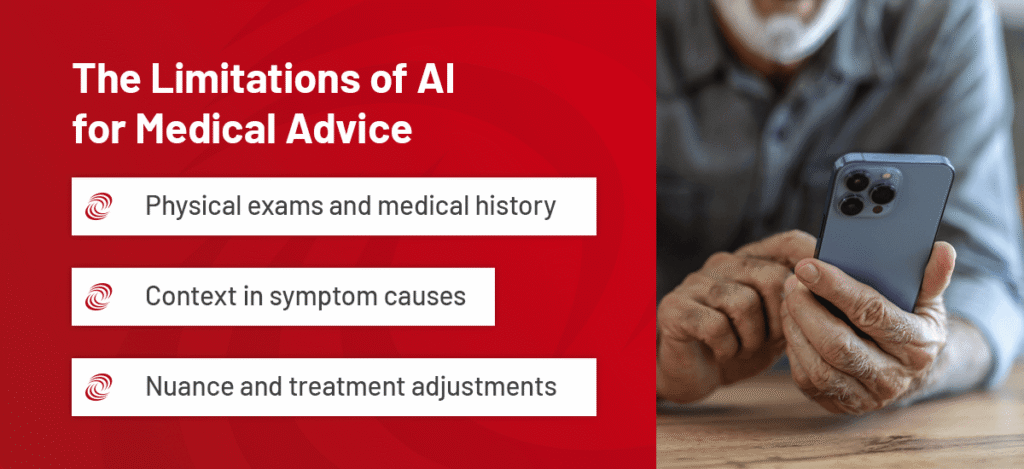
While AI provides general health information, its limitations lie in diagnosis and treatment planning. One study, which examined ChatGPT’s responses to questions about musculoskeletal disorders, found that it lacked the nuance to accurately guide patients and could potentially mislead them. Here are AI’s key limitations when it comes to medical advice:
Physical exams and medical history: AI can’t do a physical examination or understand your medical history. It can’t test your reflexes or range of motion, and it doesn’t know about any previous injuries or conditions you might have that could influence your symptoms.
Context in symptom causes: AI lacks essential context, leaving significant gaps in providing medical advice. For instance, two people with lower back pain could have entirely different underlying causes — one might have a muscle strain while another might have a herniated disc compressing a nerve root. An AI tool processes text patterns but can’t differentiate between these scenarios the way a trained spine specialist can.
Nuance and treatment adjustments: AI can’t adjust recommendations based on subtle clinical findings. A spine surgeon considers factors like the severity of nerve compression, spine stability, activity level and overall health status before recommending treatment. These nuanced decisions require human expertise and specialized training.
Certain symptoms call for immediate evaluation from spine specialists. Recognizing when to schedule a consultation can make the difference between timely treatment and prolonged complications.
If you’re dealing with persistent or worsening back pain that lasts more than a few weeks despite rest and over-the-counter remedies, it’s time for a professional evaluation. Pain that progressively intensifies or interferes with daily activities suggests an underlying issue that could benefit from early intervention.
Neurological symptoms like numbness, tingling or weakness in your legs or feet indicate potential nerve involvement. These symptoms require immediate evaluation to ensure proper diagnosis and treatment.
If your back pain began after a fall, car accident, sports injury or other trauma, you need a comprehensive evaluation even if the pain seems mild. Traumatic injuries can cause fractures, disc herniations or ligament damage that may worsen without proper treatment.
If you’ve previously been diagnosed with a spine condition or undergone spine surgery, new or recurring symptoms warrant professional evaluation rather than self-assessment through AI tools. A spine specialist familiar with your history can determine whether symptoms represent a new issue or a progression of a previous condition.
The difference between typing symptoms into a chatbot and receiving a comprehensive evaluation from spine experts is substantial. The diagnostic process involves multiple steps to identify the source of your pain and determine the most effective treatment.
Your evaluation begins with an in-depth conversation about your pain story. Spine specialists ask targeted questions about when your pain started, what makes it better or worse, how it affects your daily activities and what outcomes matter most to you. They review your medical history, including previous injuries, surgeries and chronic conditions.
This conversation provides context that AI can’t access and helps narrow down potential causes.
Your specialist conducts a thorough physical and neurological examination. They test your reflexes, muscle strength and sensation to identify signs of nerve involvement. They assess your range of motion, observe how you move and locate areas of tenderness or muscle spasm.
This hands-on evaluation reveals information that no text-based interaction can provide, including subtle neurological changes and biomechanical issues.
Diagnostic imaging reveals the internal structures of your spine. Depending on your symptoms, this might include X-rays, MRI scans or CT scans that show disc herniations, nerve compression, bone spurs, fractures and other structural issues.
At facilities specializing in comprehensive spine care, specialists interpret these images in context with your symptoms to identify the exact structure causing your discomfort. This precision diagnosis enables targeted treatment rather than the generalized suggestions an AI tool might provide.
AI can be a helpful starting point for understanding back pain terminology and treatment options, but it’s no substitute for a comprehensive evaluation and treatment by spine experts. At Desert Institute for Spine Care, our board-certified, fellowship-trained surgeons use advanced diagnostic techniques — including our proprietary Personalized Pain Mapping method — to identify the root cause of your pain and recommend the most effective treatment for your specific condition.
With over 50 years of collective experience, multiple Arizona locations and a commitment to restoring your active lifestyle, DISC is here to provide the expert care that AI cannot deliver. Schedule your consultation today and move from guesswork to a clear path toward relief.



 By Justin S. Field, M.D.